
-
admin
- June 17, 2026
What Happens to Your Ingredient After Steam Sterilization? A Complete Guide to Milling, Sieving, Blending, Packaging, and Toll Processing
What Happens After Steam Sterilization?
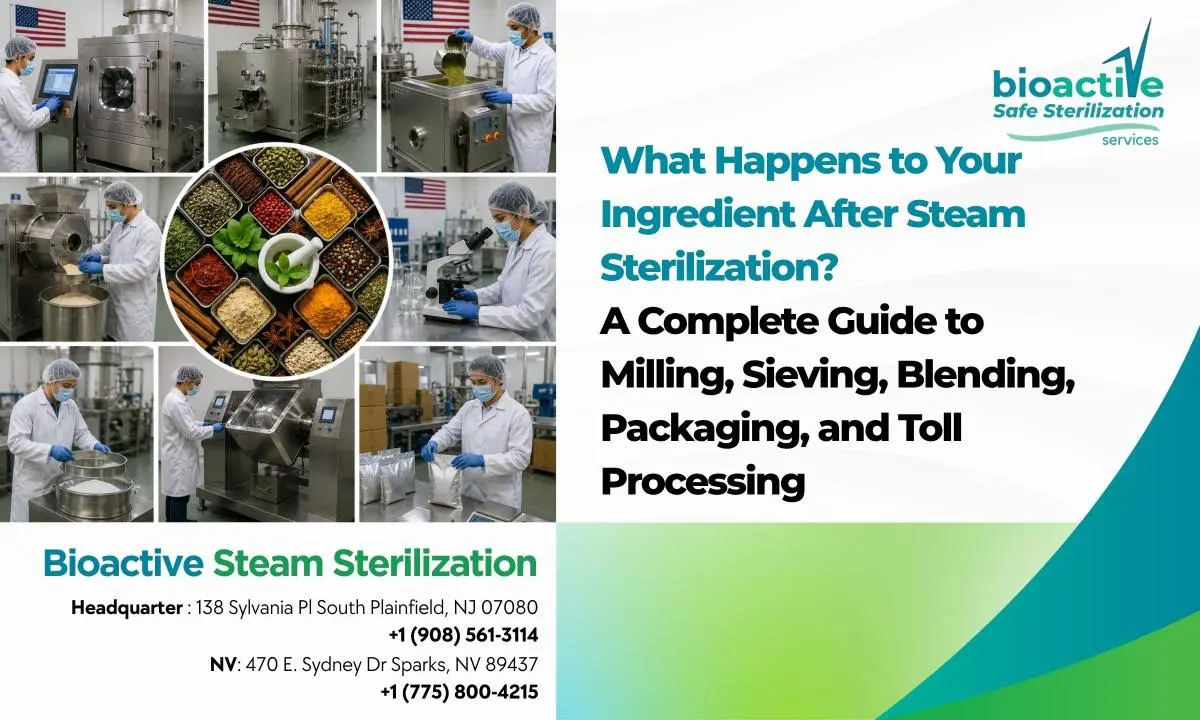
After steam sterilization, ingredients often require additional processing before they are ready for manufacturing, packaging, or distribution. Depending on the product and application, the next steps may include milling, sieving, magnetic separation, delumping, blending, and packaging. Together, these services help improve product safety, consistency, particle size, flowability, and overall quality.
For companies producing spices, herbs, nutraceuticals, dietary supplements, functional foods, and powdered ingredients, working with a provider that offers complete toll processing services can reduce costs, improve efficiency, and simplify supply chain management.
Why Steam Sterilization Is Only One Step in Ingredient Processing
Many manufacturers focus on microbial reduction through steam sterilization. While this is a critical step, sterilization alone does not prepare an ingredient for final use.
After sterilization, ingredients may still require:
- Particle size adjustment
- Removal of foreign materials
- Powder conditioning
- Ingredient blending
- Packaging and repackaging
A complete processing workflow ensures the ingredient meets customer specifications and manufacturing requirements.
Step 1: Steam Sterilization for Spices, Herbs, and Nutraceutical Ingredients
Steam sterilization is widely used to reduce microbial contamination in sensitive ingredients without relying on chemical treatments.
Common Ingredients Processed Through Steam Sterilization
- Spices
- Herbs
- Nutraceutical ingredients
- Functional food ingredients
- Organic powders
Benefits include:
- Reduction of microbial load
- Improved product safety
- Preservation of ingredient quality
- Support for regulatory compliance
- Suitable for organic ingredient processing
For manufacturers seeking steam sterilization services in the USA, this step serves as the foundation of a safe and reliable ingredient supply chain.
Step 2: Milling Services for Consistent Particle Size
Following sterilization, many ingredients require milling to achieve a specific particle size.
Milling helps manufacturers create powders that meet formulation requirements and perform consistently during production.
Benefits of Milling Services
- Improved product consistency
- Better blending performance
- Enhanced ingredient dispersion
- Customized particle sizes
- Improved manufacturing efficiency
Industries commonly using milling services include nutraceuticals, food manufacturing, dietary supplements, and ingredient processing.
Step 3: Powder Sieving and Sifting Services
After milling, powders may contain oversized particles or inconsistencies.
Powder sieving and sifting services help create a uniform product by separating particles according to size.
Advantages of Sieving and Sifting
- Consistent particle distribution
- Improved product appearance
- Better processing efficiency
- Enhanced quality control
- Reduced production issues
This step is especially important for powdered ingredients used in capsules, tablets, drink mixes, and seasoning blends.
Step 4: Magnetic Separation for Product Safety
Foreign metal contamination is a serious concern in ingredient processing.
Magnetic separation helps remove ferrous metal particles that may enter the product stream during harvesting, transportation, or manufacturing.
Why Magnetic Separation Matters
- Improves product safety
- Supports quality assurance programs
- Protects downstream equipment
- Reduces contamination risks
- Enhances customer confidence
Many food and nutraceutical manufacturers include magnetic separation as a standard quality control measure.
Step 5: Delumping Services for Improved Flowability
Powders can naturally form lumps during storage, transportation, or processing.
Delumping services break apart agglomerated material without significantly altering particle size.
Benefits of Delumping
- Improved powder flow
- Better mixing performance
- Increased processing efficiency
- Reduced production downtime
- More consistent product quality
This step is particularly useful for powdered herbs, spices, and nutraceutical ingredients.
Step 6: Blending Services for Uniform Product Quality
Many finished products require multiple ingredients to be combined into a consistent formulation.
Professional blending services ensure every batch meets precise specifications.
Applications of Blending Services
- Nutraceutical formulations
- Dietary supplement blends
- Functional food products
- Seasoning mixes
- Custom ingredient formulations
Proper blending helps ensure uniformity, ingredient distribution, and product performance.
Step 7: Packaging and Repackaging Solutions
Once processing is complete, ingredients must be packaged according to customer requirements.
Packaging and repackaging services help manufacturers prepare products for storage, transportation, and distribution.
Packaging Options May Include
- Bulk packaging
- Tote packaging
- Drum packaging
- Custom packaging formats
- Contract packaging solutions
Packaging is the final step that transforms a processed ingredient into a market-ready product.
What Is Sterilization Toll Processing?
Sterilization toll processing refers to outsourcing ingredient processing services to a specialized facility.
Instead of investing in expensive equipment and dedicated production lines, manufacturers can partner with a toll processor to handle specific processing requirements.
Services often include:
- Steam sterilization
- Milling
- Sieving and sifting
- Magnetic separation
- Delumping
- Blending
- Packaging
This approach helps businesses reduce capital expenses while accessing specialized expertise.
Can One Company Handle the Entire Ingredient Processing Workflow?
Yes. Many manufacturers prefer working with a single processing partner that can manage the entire workflow from sterilization through packaging.
Benefits include:
- Simplified logistics
- Faster turnaround times
- Reduced transportation costs
- Consistent quality control
- Improved supply chain efficiency
- Single point of accountability
This integrated approach is becoming increasingly popular among food, nutraceutical, and supplement manufacturers.
Why Choose Bioactive Safe Sterile or Steam Sterilization for End-to-End Ingredient Processing?
For manufacturers looking for a streamlined solution, working with a single processing partner can simplify every stage of ingredient preparation. Bioactive Safe Sterile or Steam Sterilization provides a comprehensive range of services, including steam sterilization, milling, powder sieving and sifting, magnetic separation, delumping, blending, packaging, and repackaging.
By offering multiple processing capabilities under one roof, Bioactive Safe Sterile or Steam Sterilization helps reduce transportation between facilities, improve quality control, and support efficient production workflows. This integrated approach can help manufacturers save time, maintain product consistency, and move ingredients from raw material to finished packaged product more efficiently.
Whether a company requires steam sterilization for spices, herbs, nutraceutical ingredients, or organic powders, having access to complete toll processing services through a single provider can simplify supply chain management and improve operational efficiency.
Industries That Benefit from End-to-End Ingredient Processing
Nutraceutical Industry
Manufacturers require safe, consistent, and precisely processed ingredients for supplements and wellness products.
Food Manufacturing
Ingredient quality directly impacts product safety, taste, and shelf stability.
Spice Industry
Steam sterilization and particle size control help maintain quality standards.
Herbal Product Manufacturers
Processing services improve safety, consistency, and manufacturing performance.
Functional Food Companies
Integrated processing solutions support complex ingredient formulations.
Frequently Asked Questions
What happens after steam sterilization?
Ingredients may undergo milling, sieving, magnetic separation, delumping, blending, and packaging depending on customer requirements.
Why is milling performed after sterilization?
Milling helps achieve a specific particle size and improves product consistency.
What is powder sieving used for?
Sieving removes oversized particles and creates a more uniform powder.
Why is magnetic separation important?
Magnetic separation helps remove metal contaminants and improves product safety.
What is toll processing?
Toll processing involves outsourcing ingredient processing services to a specialized facility.
Can steam sterilization and packaging be handled by one provider?
Many ingredient processing companies offer integrated solutions that include sterilization, blending, and packaging.
Conclusion
Steam sterilization is an essential step in producing safe, high-quality ingredients, but it is only one part of the overall processing journey. To meet manufacturing specifications and customer expectations, ingredients often require additional services such as milling, sieving, magnetic separation, delumping, blending, and packaging.
By partnering with a provider that offers complete sterilization toll processing services, manufacturers can streamline operations, maintain product quality, and bring ingredients to market more efficiently.