
-
admin
- September 2, 2026
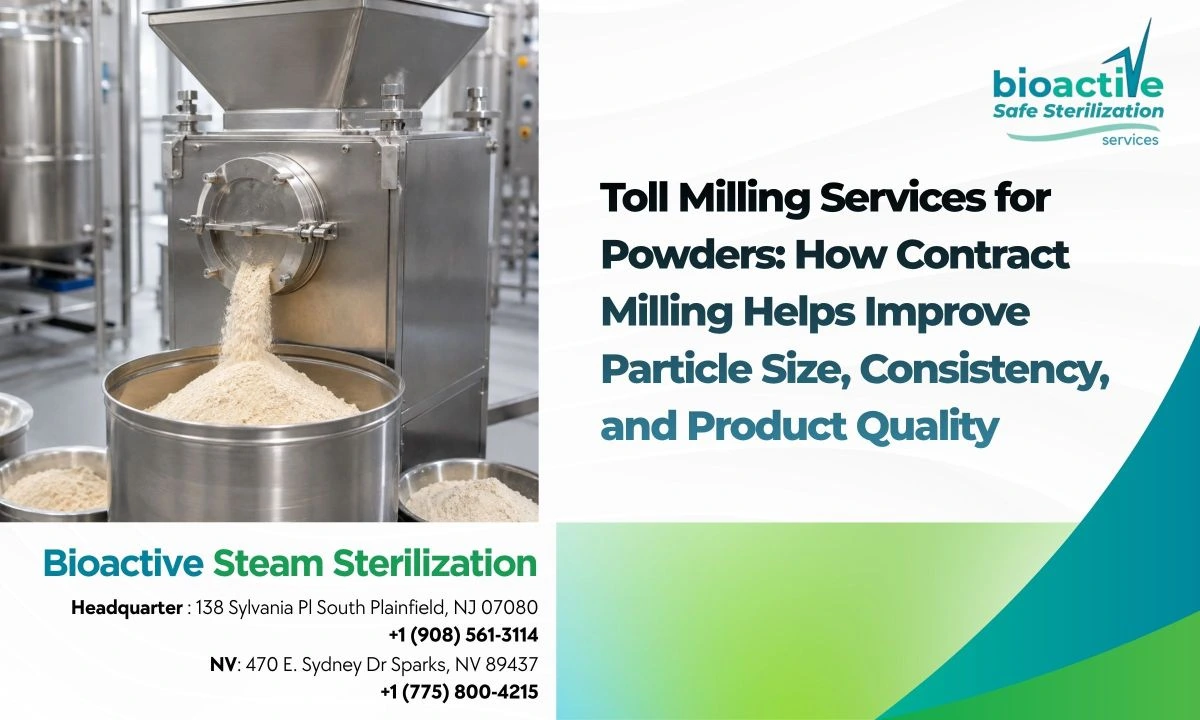
Toll Milling Services for Powders: How Contract Milling Helps Improve Particle Size, Consistency, and Product Quality
When manufacturers work with powdered ingredients, achieving the right particle size and consistency can be just as important as sourcing high-quality raw materials. Powders that are too coarse, too fine, unevenly sized, or prone to clumping can create problems during blending, formulation, encapsulation, packaging, and final-product manufacturing.
This is where toll milling services for powders can help.
Toll milling allows companies to outsource the grinding and particle-size reduction of their powdered ingredients to a specialized processing partner instead of investing in milling equipment, maintenance, operators, and facility infrastructure.
For food, nutraceutical, pharmaceutical, supplement, and other powdered-ingredient manufacturers, a professional toll milling partner can provide controlled particle-size reduction, improved powder uniformity, and processing tailored to specific product requirements.
Bioactive Safe Sterile or Steam Sterilization provides precision milling and toll processing solutions designed to support powdered ingredients that require consistent particle size, improved solubility, optimized texture, and controlled processing. Its milling capabilities can also be combined with other services such as steam sterilization, blending, screening, and packaging.
What Are Toll Milling Services for Powders?
Toll milling is an outsourced processing service in which a manufacturer sends its raw material to a specialized milling company for grinding or particle-size reduction.
Instead of purchasing and operating its own milling equipment, a manufacturer can work with a toll processor that already has the necessary machinery, technical expertise, quality controls, and processing infrastructure.
The milling company processes the material according to agreed specifications and returns the finished powder to the customer.
Depending on the material and application, toll milling may be used to:
- Reduce particle size
- Produce a more uniform powder
- Achieve a specific mesh or particle-size specification
- Improve powder flow
- Improve solubility or dispersion
- Optimize texture
- Prepare ingredients for blending or encapsulation
- Support consistent downstream manufacturing
For companies that process powdered ingredients regularly but do not want the capital expense of operating an in-house milling facility, toll milling can be a practical solution.
Why Is Particle Size Important for Powdered Ingredients?
Particle size can influence how a powder behaves throughout the manufacturing process.
Two powders made from the same raw material can perform differently if their particle-size distributions are different.
Particle size can affect:
- Flowability
- Mixing and blending
- Dispersion
- Solubility
- Texture
- Packaging performance
- Encapsulation
- Product consistency
For example, a powder with inconsistent particle sizes may separate during transportation or blending. Oversized particles can also affect the appearance and performance of a finished product.
Precision milling helps manufacturers work toward a more consistent particle-size profile based on their product requirements.
According to Bioactive Safe Sterile or Steam Sterilization, its milling service is designed to provide consistent particle size, enhanced solubility, and optimized texture for powdered ingredients.
What Types of Powders Can Be Toll Milled?
The suitability of a material for toll milling depends on its physical characteristics, processing requirements, intended application, and desired particle size.
Toll milling may be suitable for powdered ingredients used in:
- Nutraceutical products
- Dietary supplements
- Functional foods
- Food ingredients
- Spices and seasoning ingredients
- Pharmaceutical applications
- Cosmetic formulations
- Other specialty powdered products
Before processing, manufacturers should discuss the material characteristics and required specifications with the toll milling provider.
Important information may include the starting particle size, target particle size, moisture sensitivity, material density, flow characteristics, desired throughput, and intended end use.
What Are the Benefits of Outsourcing Powder Milling?
One of the biggest advantages of toll milling is that manufacturers do not necessarily need to purchase and maintain their own milling equipment.
1. Lower Capital Investment
Setting up an in-house milling operation can require significant investment in equipment, facility space, maintenance, utilities, safety systems, and trained personnel.
Outsourcing allows manufacturers to access professional processing capabilities without making the same level of capital investment.
2. Consistent Particle Size
A specialized milling provider can process ingredients according to defined particle-size requirements.
Greater consistency can help manufacturers achieve more predictable performance during subsequent production stages.
3. Improved Powder Performance
The appropriate milling process may help improve characteristics such as flowability, dispersion, solubility, and texture.
This can be particularly valuable when powders need to perform consistently during blending, formulation, filling, or packaging.
4. Flexible Processing
Toll processing can allow companies to outsource specific production stages rather than building an entire processing operation internally.
This can be useful for product development, growing brands, established manufacturers, and companies entering new markets.
5. Access to Processing Expertise
Working with an experienced toll processor provides access to specialized equipment and technical knowledge that may otherwise require significant internal resources.
How Does the Toll Milling Process Work?
Although the exact process depends on the material and milling equipment, a typical toll milling project can follow several stages.
Step 1: Material Evaluation
The processor reviews the raw material and its processing requirements.
Information such as initial particle size, moisture content, material behavior, desired output, and application can help determine the appropriate processing approach.
Step 2: Define the Particle-Size Requirement
The customer and processor establish the desired particle-size specification.
This could involve a target range, mesh specification, or other quality requirement.
Step 3: Milling
The material is processed using appropriate milling equipment to reduce particle size.
The milling conditions may be adjusted depending on the characteristics of the ingredient and the desired finished powder.
Step 4: Screening or Classification
After milling, screening or particle classification may be used when additional control over particle size is required.
Screening is different from milling: milling reduces particle size, while screening separates particles according to size. Bioactive Safe Sterile or Steam Sterilization also provides dry powder sieving and toll screening services for manufacturers that require controlled particle-size classification.
Step 5: Quality Checks
The processed powder can be evaluated against the agreed specifications.
Depending on the product and project requirements, quality checks may focus on particle size, consistency, handling characteristics, and other relevant parameters.
Step 6: Additional Processing
Depending on the project, milling may be combined with other processing services.
For example, manufacturers may require:
Milling → Steam Sterilization → Blending → Packaging
or another sequence based on their product and quality requirements.
Can Toll Milling Be Combined With Steam Sterilization?
Yes, depending on the material and processing requirements, milling can be part of a broader powder-processing program that includes steam sterilization.
This can be particularly useful for manufacturers that want to reduce the number of external processing partners involved in their supply chain.
Bioactive Safe Sterile or Steam Sterilization provides milling alongside steam sterilization, toll blending, packaging, and other powder-processing capabilities. Its website states that its steam sterilization process is designed to provide validated 5-log pathogen reduction while maintaining ingredient quality.
For ingredients requiring microbial reduction, combining appropriate milling and sterilization services under one processing partner can potentially simplify logistics and reduce additional handling.
The exact processing sequence should be determined based on the ingredient, microbial requirements, target particle size, and product specifications.
Should Powder Be Milled Before or After Steam Sterilization?
There is no single sequence that is appropriate for every powder.
The correct order depends on factors such as:
- Ingredient characteristics
- Target particle size
- Moisture sensitivity
- Microbial specifications
- Heat and processing sensitivity
- Desired final product characteristics
- Packaging requirements
In some applications, milling before sterilization may be appropriate, while in others the processing sequence may need to be different.
A qualified toll processor should evaluate the material and determine the most suitable processing approach rather than applying the same sequence to every ingredient.
What Should You Look for in a Toll Milling Company?
Choosing the right toll milling partner is important because milling directly affects the consistency and performance of the finished powder.
Before selecting a supplier, manufacturers should consider:
Processing Capabilities
Does the company have the equipment and experience required for your material and target particle size?
Particle-Size Control
Can the processor consistently meet your required particle-size specification?
Quality Systems
Does the facility follow appropriate food safety, GMP, and quality-control procedures for your application?
Bioactive Safe Sterile or Steam Sterilization states that its processing follows applicable quality and regulatory requirements and lists certifications including HACCP, USDA Organic, Halal, India Organic, and GMP.
Additional Services
If you need more than milling, consider whether the same provider can support additional requirements such as:
- Steam sterilization
- Toll blending
- Screening
- Packaging
- Repackaging
- Quality testing
Using complementary services from one processing partner can simplify coordination across the supply chain.
Scalability
Ask whether the processor can support your current production volume as well as future growth.
Material Handling
Different powders behave differently. The processor should understand factors such as moisture, density, flowability, particle structure, and sensitivity to processing conditions.
Toll Milling vs. In-House Milling: Which Is Better?
The right choice depends on your production volume, budget, technical capabilities, and long-term manufacturing strategy.
In-house milling may make sense for manufacturers with high, predictable volumes and the resources to operate and maintain milling equipment.
Toll milling may be more attractive for companies that want to:
- Avoid major equipment investments
- Reduce maintenance responsibilities
- Access specialized processing capabilities
- Scale production more flexibly
- Focus internal resources on formulation and manufacturing
- Outsource a specific processing stage
For smaller manufacturers, new product launches, and companies with fluctuating production requirements, toll milling can offer greater flexibility.
Can Toll Milling Improve Powder Solubility?
Milling can influence the physical characteristics of a powder, including surface area and particle-size distribution. Depending on the ingredient, reducing and controlling particle size may contribute to improved dispersion or solubility.
However, milling does not automatically guarantee improved solubility for every material.
Solubility is influenced by multiple factors, including the chemical properties of the ingredient, formulation, particle characteristics, temperature, and processing conditions.
Therefore, the target particle size should be selected based on the final product’s requirements rather than simply choosing the finest possible powder.
What Is the Difference Between Toll Milling and Toll Processing?
Toll milling is a specific type of toll processing focused primarily on particle-size reduction.
Toll processing is a broader term that can include several outsourced manufacturing or processing activities.
For powdered ingredients, toll processing may include:
- Milling
- Screening
- Sieving
- Blending
- Steam sterilization
- Packaging
- Repackaging
A manufacturer may therefore use a toll processor for one service or combine several services into a complete processing workflow.
Why Choose Bioactive Safe Sterile or Steam Sterilization for Powder Processing?
Bioactive Safe Sterile or Steam Sterilization offers an integrated approach to powdered ingredient processing.
Its milling service focuses on precision particle-size control, consistent powder quality, solubility, and texture. The company also provides steam sterilization, toll blending, packaging, and other processing solutions.
This integrated model can be useful for manufacturers that want to manage multiple processing stages through one experienced partner.
The company’s facilities in New Jersey and Nevada support its U.S. processing operations, while its services are designed for industries including food, nutraceutical, pharmaceutical, and supplement applications.
Frequently Asked Questions About Toll Milling Services for Powders
What is toll milling for powders?
Toll milling is an outsourced powder-processing service where a specialized company reduces the particle size of a customer’s raw material according to specified requirements.
Why do companies use toll milling services?
Companies use toll milling to access specialized equipment and expertise without investing heavily in their own milling infrastructure. It can also help achieve consistent particle size and improve powder-processing efficiency.
What is the difference between milling and screening?
Milling reduces the size of particles, while screening separates particles into different size ranges. Both processes can be used together when precise particle-size control is required.
Can toll milling be used for food ingredients?
Yes. Toll milling can be used for various food and powdered ingredients, provided the material is suitable for the selected processing equipment and the facility follows appropriate food-safety procedures.
Can nutraceutical powders be toll milled?
Yes. Nutraceutical and dietary ingredients can be suitable for toll milling when their physical characteristics and processing requirements are properly evaluated.
Can I specify the particle size I need?
In many toll milling projects, customers provide a target particle-size range or mesh specification. The processor then determines the appropriate milling and classification approach to meet the requirement.
Can milling and steam sterilization be done by the same company?
Yes. Some toll processing companies offer both milling and steam sterilization as part of an integrated processing solution. Bioactive Safe Sterile or Steam Sterilization provides both milling and steam sterilization services.
How do I choose the right toll milling service?
Consider the processor’s equipment, experience with your material, particle-size capabilities, quality systems, production capacity, certifications, and ability to provide additional services such as screening, sterilization, blending, and packaging.
Conclusion
Toll milling services for powders can help manufacturers achieve more consistent particle sizes while avoiding the cost and complexity of maintaining an in-house milling operation.
For food, nutraceutical, pharmaceutical, supplement, and other powdered-ingredient applications, the right milling partner can support better powder consistency, processing performance, solubility, texture, and downstream manufacturing.
When milling is combined with services such as Steam Sterilization, screening, blending, and packaging, manufacturers can potentially simplify their supply chain and reduce the number of processing partners they need to manage.
For businesses looking for a specialized U.S. powder-processing partner, Bioactive Safe Sterile or Steam Sterilization offers milling alongside steam sterilization and other toll-processing services designed around individual ingredient and product requirements.
Looking for toll milling services for your powdered ingredients? Contact Bioactive Safe Sterile or Steam Sterilization to discuss your material, target particle size, processing requirements, and additional services you may need.