
-
admin
- July 28, 2026
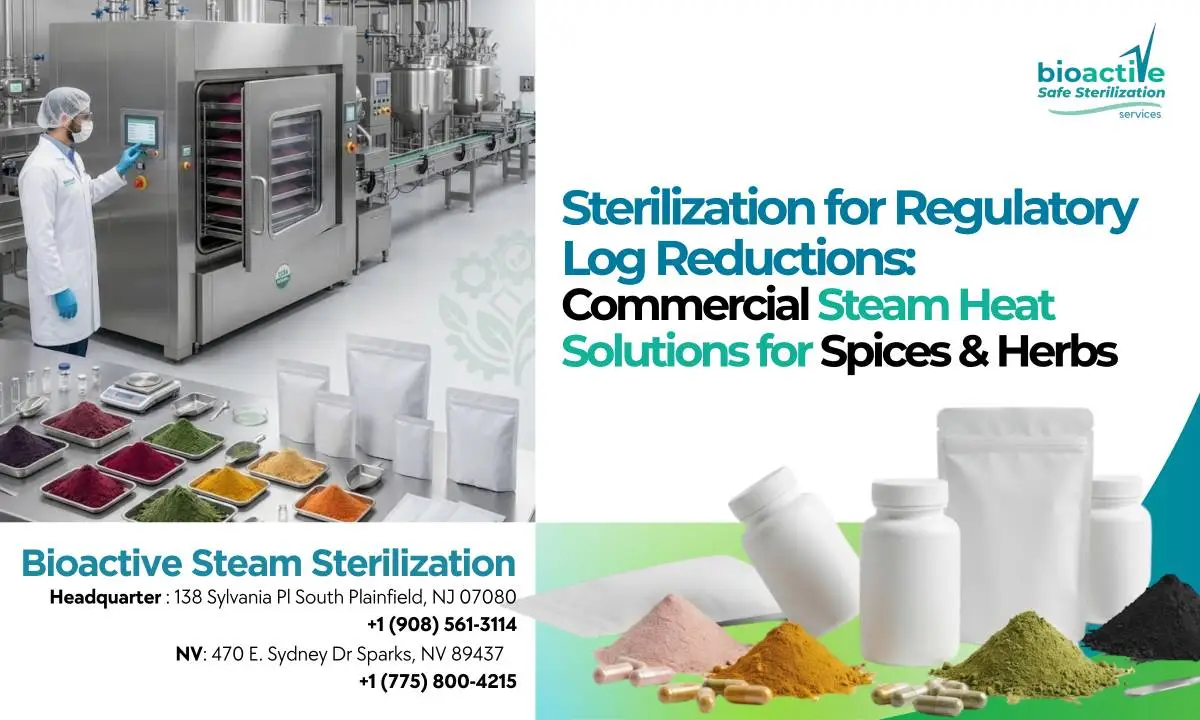
Sterilization for Regulatory Log Reductions: Commercial Steam Heat Solutions for Spices & Herbs
Ensuring microbiological safety has become one of the most important responsibilities for food manufacturers handling spices, herbs, botanical ingredients, nutraceuticals, and other powdered food products. These low-moisture ingredients may appear stable, yet they can harbor microorganisms acquired during cultivation, harvesting, drying, transportation, and storage.
To manage these risks, manufacturers increasingly rely on sterilization for regulatory log reductions through validated commercial processing technologies. Among the available methods, commercial steam heat sterilization has become one of the most widely adopted approaches because it effectively reduces microbial populations while helping preserve ingredient quality.
At Bioactive Services, we provide commercial steam sterilization, validated pathogen reduction, toll blending, custom formulation, and packaging services for powdered ingredients used throughout the food, nutraceutical, and life sciences industries. This guide explains regulatory log reductions, how commercial steam sterilization supports food safety programs, and what manufacturers should consider when selecting a trusted processing partner.
What Are Regulatory Log Reductions?
Understanding Log Reduction in Food Safety
A log reduction is a scientific measurement used to express how effectively a microbial control process reduces the number of microorganisms present in a product.
The logarithmic scale is commonly expressed as:
Log Reduction | Percentage Reduction |
1-Log | 90% |
2-Log | 99% |
3-Log | 99.9% |
4-Log | 99.99% |
5-Log | 99.999% |
A 5-log reduction means that a microbial population has been reduced by 99.999%, making it a widely recognized benchmark in many food safety validation programs.
Why Log Reductions Matter for Powdered Ingredients
Unlike refrigerated foods, low-moisture products can allow certain microorganisms to survive for extended periods. Ingredients such as spices, herbs, botanical powders, and nutraceutical blends are frequently added to finished products without additional lethality treatments.
Validated microbial reduction helps manufacturers:
- Improve ingredient safety
- Meet customer microbial specifications
- Support preventive food safety programs
- Reduce recall risks
- Strengthen supplier qualification programs
FDA and FSMA Preventive Control Requirements
The Food Safety Modernization Act (FSMA) shifted the focus of food safety toward prevention rather than reaction. Manufacturers are expected to identify biological hazards, implement preventive controls, validate those controls, and maintain documentation demonstrating that the process consistently performs as intended.
Although required microbial reduction levels vary depending on the product and hazard analysis, validated sterilization processes can serve as an important preventive control within an overall food safety plan.
Why Spices and Herbs Require Validated Sterilization
Natural Sources of Microbial Contamination
Spices and herbs originate from agricultural environments where they are exposed to soil, water, wildlife, harvesting equipment, drying conditions, transportation, and storage. These factors contribute to naturally occurring microbial populations that can persist throughout the supply chain.
High-Risk Botanical Ingredients
Ingredients commonly processed through commercial steam sterilization include:
- Black pepper
- Paprika
- Garlic powder
- Onion powder
- Turmeric
- Cinnamon
- Oregano
- Basil
- Rosemary
- Botanical extracts
- Herbal powders
- Functional plant ingredients
These products often require validated microbial reduction before use in food, dietary supplements, and functional formulations.
The Impact on Food Manufacturers
Without appropriate microbial controls, manufacturers may face:
- Product recalls
- Production delays
- Supplier qualification issues
- Customer complaints
- Increased testing costs
- Regulatory scrutiny
- Brand reputation risks
Implementing validated sterilization helps reduce these risks while improving confidence throughout the supply chain.
Commercial Steam Heat Sterilization
How Steam Heat Sterilization Works
Commercial steam heat sterilization uses carefully controlled combinations of heat, moisture, pressure, and exposure time to reduce microbial populations on powdered ingredients.
Unlike household cooking, industrial systems continuously monitor critical process parameters to deliver repeatable and validated performance across production batches.
This controlled approach helps manufacturers achieve microbial reduction objectives while minimizing impacts on product quality.
Achieving Validated 5-Log Pathogen Reduction
Many manufacturers require processing partners capable of supporting validated 5-log pathogen reduction programs for ingredients such as spices, herbs, nutraceutical powders, and specialty food systems.
A validated program typically includes:
- Scientific process development
- Challenge studies when appropriate
- Equipment qualification
- Batch monitoring
- Process verification
- Microbial testing
- Documentation and recordkeeping
These activities demonstrate that the sterilization process consistently achieves the intended microbial reduction under defined operating conditions.
Preserving Ingredient Quality
One of the key advantages of commercial steam heat sterilization is its ability to balance food safety with product quality.
Properly optimized processes help preserve:
- Flavor
- Aroma
- Natural color
- Functional characteristics
- Nutritional value
- Flowability
This makes steam heat sterilization particularly suitable for premium spices, herbs, botanical ingredients, and nutraceutical powders.
Validation and Regulatory Compliance
Scientific Process Validation
Validation confirms that a sterilization process is capable of delivering the required microbial reduction under specified operating conditions.
Validation activities may include:
- Laboratory testing
- Challenge studies
- Process qualification
- Statistical evaluation
- Ongoing verification
A scientifically validated process builds confidence in product safety and consistency.
Monitoring Critical Process Parameters
Reliable sterilization depends on continuous monitoring of factors such as:
- Temperature
- Moisture
- Exposure time
- Pressure
- Product flow
- Equipment performance
Automated controls and documented monitoring help ensure every production batch meets established process specifications.
Documentation and Traceability
Comprehensive documentation is essential for supporting customer audits, regulatory inspections, and supplier qualification programs.
Important records include:
- Batch production records
- Process monitoring data
- Validation reports
- Calibration records
- Traceability documentation
- Quality assurance reviews
Strong documentation practices demonstrate process consistency and support regulatory readiness.
Choosing the Right Sterilization Partner
Selecting a contract processing partner involves more than evaluating equipment. Manufacturers should assess the provider’s technical capabilities, quality systems, and ability to support long-term production goals.
Technical Expertise
An experienced provider understands the unique processing requirements of powdered ingredients and can optimize sterilization parameters while protecting product quality.
Quality Assurance Systems
Look for partners with robust quality management systems that include:
- Validated operating procedures
- Equipment maintenance
- Batch traceability
- Internal audits
- Continuous improvement programs
- Employee training
Integrated Toll Processing Services
Many manufacturers benefit from partners that offer multiple production capabilities, including:
- Commercial steam sterilization
- Toll blending
- Custom formulation
- Packaging
- Ingredient handling
- Production support
Integrating these services under one provider helps reduce handling, simplify logistics, and improve operational efficiency.
Why Bioactive Services Is a Trusted Processing Partner
At Bioactive Services, we provide more than commercial sterilization—we offer complete manufacturing solutions for powdered ingredients used across the food, nutraceutical, botanical, and life sciences industries.
Commercial Steam Sterilization
Our advanced steam heat sterilization systems are designed to support validated microbial reduction while maintaining ingredient quality and functionality.
Pathogen Reduction Programs
We work with manufacturers to implement scientifically supported microbial reduction strategies that align with product specifications and food safety objectives.
Toll Blending, Formulation & Packaging
In addition to sterilization, our integrated services include:
- Toll blending
- Custom formulation
- Packaging
- Production support
By combining these capabilities within one quality-managed operation, we help customers simplify their supply chains and improve manufacturing efficiency.
Frequently Asked Questions
What is sterilization for regulatory log reductions?
It refers to validated microbial reduction processes designed to achieve measurable reductions in microorganisms that support food safety objectives and regulatory compliance.
Why are spices and herbs commonly sterilized?
Spices and herbs are agricultural products that can naturally contain microorganisms acquired during growing, harvesting, drying, and transportation. Sterilization helps reduce these microbial populations before use in finished products.
What is a 5-log pathogen reduction?
A 5-log reduction represents a 99.999% reduction in the target microorganism population and is commonly used as a benchmark in food safety validation programs.
Why is steam heat sterilization preferred for powdered ingredients?
Steam heat sterilization provides effective microbial reduction while helping preserve flavor, aroma, color, and functional properties compared with many alternative methods.
Does Bioactive Services offer more than sterilization?
Yes. Bioactive Services provides commercial steam sterilization, pathogen reduction, toll blending, formulation development, packaging, and integrated manufacturing support for powdered ingredients.
Conclusion
As food manufacturers continue to strengthen preventive food safety programs, sterilization for regulatory log reductions has become an essential part of producing safe, high-quality powdered ingredients. For spices, herbs, nutraceuticals, and botanical products, validated commercial steam heat sterilization offers an effective way to reduce microbial contamination while preserving the sensory and functional characteristics that customers expect.
At Bioactive Services, we combine advanced steam heat sterilization with validated pathogen reduction, toll blending, custom formulation, packaging, and end-to-end manufacturing support. Our integrated approach helps customers streamline production, maintain regulatory readiness, and deliver consistent product quality from raw ingredient to finished package.
If your organization is seeking a trusted partner for microbial reduction and powder processing, Bioactive Services is ready to help you meet your food safety and manufacturing objectives.
Learn more about our commercial steam sterilization and integrated processing solutions by visiting Bioactive Services.