
-
admin
- June 22, 2026
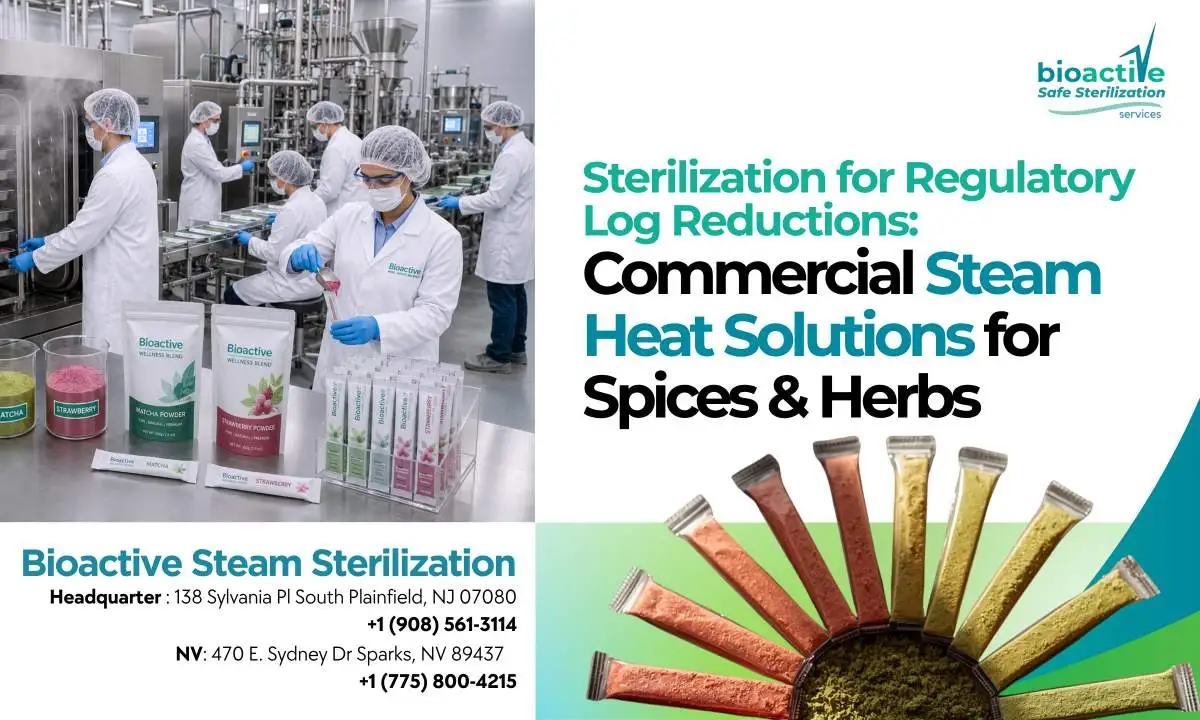
Sterilization for Regulatory Log Reductions: Commercial Steam Heat Solutions for Spices & Herbs
Spices and herbs are among the most valuable ingredients in the global food, nutraceutical, and botanical markets. They add flavor, aroma, functionality, and nutritional value to countless products. However, because these ingredients originate from agricultural environments, they are also among the most vulnerable to microbial contamination.
Manufacturers face increasing pressure to ensure microbial safety while meeting regulatory requirements and maintaining ingredient quality. As a result, sterilization for regulatory log reductions has become a critical component of modern food safety programs.
At Bioactive Services, we help manufacturers achieve validated microbial reduction through commercial steam heat sterilization solutions designed specifically for spices, herbs, and powdered ingredients. This guide explains how regulatory log reductions work, why steam heat sterilization is widely used, and how manufacturers can select the right processing partner.
Understanding Regulatory Log Reductions in Food Safety
What Is a Log Reduction?
A log reduction is a mathematical measurement used to evaluate how effectively a process reduces microbial populations.
Examples include:
Log Reduction | Percentage Reduction |
1-Log | 90% |
2-Log | 99% |
3-Log | 99.9% |
4-Log | 99.99% |
5-Log | 99.999% |
The higher the log reduction, the greater the decrease in microbial contamination.
Why Regulatory Log Reductions Matter
Regulatory agencies and food safety programs require manufacturers to implement controls that effectively reduce biological hazards.
Log reductions serve as measurable evidence that a microbial control process is working as intended.
Benefits include:
- Improved food safety
- Reduced contamination risks
- Stronger quality assurance programs
- Enhanced customer confidence
- Better regulatory readiness
FDA and FSMA Expectations for Microbial Control
The Food Safety Modernization Act (FSMA) emphasizes prevention rather than reaction.
Manufacturers are expected to:
- Identify microbial hazards
- Establish preventive controls
- Validate process effectiveness
- Monitor critical parameters
- Maintain supporting documentation
Commercial sterilization processes often serve as key preventive controls for powdered ingredients.
Why Spices and Herbs Require Sterilization
Sources of Microbial Contamination
Spices and herbs encounter numerous contamination opportunities throughout the supply chain.
Potential sources include:
- Soil
- Water
- Harvesting equipment
- Drying operations
- Transportation systems
- Storage facilities
These environmental exposures contribute to naturally occurring microbial loads.
Common Pathogens Found in Botanical Ingredients
Although contamination levels vary, concerns often include:
- Salmonella
- E. coli
- Bacillus species
- Yeasts
- Molds
Because spices and herbs are frequently added to ready-to-eat foods, microbial risks must be carefully managed.
Risks of Untreated Ingredients
Failure to reduce microbial contamination can lead to:
- Product recalls
- Regulatory investigations
- Supply chain disruptions
- Financial losses
- Consumer health risks
For this reason, sterilization has become a standard practice across many sectors.
How Commercial Steam Heat Sterilization Works
The Science Behind Steam Heat Processing
Steam heat sterilization uses controlled combinations of heat and moisture to reduce microbial populations.
Unlike some alternative technologies, steam sterilization penetrates ingredient surfaces efficiently while helping preserve important product characteristics.
The process is specifically engineered to achieve microbial reduction targets without unnecessary product degradation.
Temperature, Moisture, and Time Control
Successful sterilization depends on carefully managing three critical variables:
Temperature
Heat levels must be sufficient to reduce target microorganisms.
Moisture
Steam provides moisture that enhances heat transfer and microbial destruction.
Time
Exposure duration must be optimized to balance safety and quality.
Modern systems use automated controls to ensure consistency throughout production.
Validation and Monitoring Procedures
Effective sterilization programs include:
- Process validation
- Equipment calibration
- Batch monitoring
- Microbial testing
- Documentation systems
These activities help verify that target reductions are consistently achieved.
Achieving 5-Log Pathogen Reduction in Spices & Herbs
What a 5-Log Reduction Means
A 5-log reduction represents a 99.999% decrease in a targeted microorganism population.
For example:
If one million microorganisms are present before processing, a validated 5-log reduction would reduce the population to approximately ten surviving organisms.
This benchmark is widely recognized across food safety programs.
Validation Requirements
Achieving a target reduction requires scientific validation.
Validation may include:
- Challenge studies
- Process verification
- Laboratory testing
- Data analysis
The goal is to demonstrate that the process consistently performs as expected.
Maintaining Consistency Across Production Batches
Consistency is essential for compliance and customer confidence.
Critical success factors include:
- Standardized operating procedures
- Equipment maintenance
- Continuous monitoring
- Employee training
- Quality control programs
Benefits of Steam Heat Sterilization for Spices and Herbs
Effective Microbial Reduction
Steam heat sterilization offers strong pathogen reduction capabilities while supporting food safety objectives.
Manufacturers commonly use this technology to reduce contamination risks in:
- Pepper
- Paprika
- Garlic powder
- Onion powder
- Turmeric
- Cinnamon
- Herbal ingredients
Preservation of Flavor and Aroma
One of the most important advantages of steam sterilization is its ability to maintain sensory characteristics.
Properly designed systems help preserve:
- Flavor intensity
- Natural aroma
- Color quality
- Ingredient functionality
Support for Organic and Clean Label Products
Consumer demand for minimally processed ingredients continues to grow.
Steam sterilization supports these preferences because it:
- Avoids chemical treatments
- Supports clean-label initiatives
- Aligns with many organic processing objectives
Selecting a Sterilization Partner for Regulatory Compliance
Process Validation Capabilities
Manufacturers should seek partners that can demonstrate:
- Scientific validation
- Process consistency
- Performance monitoring
- Microbial testing support
Industry Experience with Botanical Ingredients
Not all sterilization providers specialize in spices and herbs.
Experience with botanical ingredients helps ensure:
- Better quality preservation
- More effective processing
- Improved operational efficiency
Quality Assurance and Documentation Systems
Strong providers maintain:
- Batch records
- Traceability systems
- Validation documentation
- Quality management programs
These systems support customer audits and regulatory inspections.
Why Bioactive Services Is a Trusted Steam Sterilization Partner
At Bioactive Services, we help food, nutraceutical, and botanical manufacturers implement effective microbial reduction strategies while protecting ingredient quality.
Expertise in Powdered Ingredient Processing
Our team specializes in processing:
- Spices
- Herbs
- Nutraceutical powders
- Botanical ingredients
- Functional food systems
Commercial Steam Heat Sterilization Solutions
We provide advanced steam sterilization services designed to support microbial reduction objectives while preserving product integrity.
Our approach focuses on:
- Consistency
- Quality
- Compliance
- Scalability
Integrated Toll Blending and Packaging Support
In addition to sterilization, we offer:
- Toll blending services in USA
- Custom formulations
- Packaging solutions
- Manufacturing support
This integrated model helps streamline production and reduce supply chain complexity.
Frequently Asked Questions
What is sterilization for regulatory log reductions?
It refers to validated microbial reduction processes designed to achieve measurable pathogen reductions that support food safety and regulatory compliance objectives.
Why are spices and herbs commonly sterilized?
Because they originate from agricultural environments, spices and herbs often carry microorganisms that must be reduced to improve food safety.
What is a 5-log pathogen reduction?
A 5-log reduction represents a 99.999% decrease in targeted microorganisms and is widely used as a food safety benchmark.
Why is steam heat sterilization used for spices?
Steam heat sterilization effectively reduces microbial contamination while helping preserve flavor, aroma, and product quality.
Can sterilization be combined with toll blending services?
Yes. Many manufacturers choose integrated providers that offer sterilization, blending, formulation, and packaging services.
Conclusion: Achieving Regulatory Log Reductions with Commercial Steam Heat Sterilization
As food safety expectations continue to evolve, manufacturers must implement reliable microbial control strategies that support regulatory compliance and product quality.
For spices and herbs, commercial steam heat sterilization remains one of the most effective approaches for achieving meaningful microbial reductions while preserving ingredient integrity.
At Bioactive Services, we provide comprehensive solutions that combine:
- Commercial steam heat sterilization
- Pathogen reduction programs
- Toll blending services
- Formulation support
- Packaging solutions
Our integrated approach helps food, nutraceutical, and botanical manufacturers achieve their safety, compliance, and production objectives.
To learn more about our sterilization and ingredient processing capabilities, visit: