
-
admin
- August 25, 2026
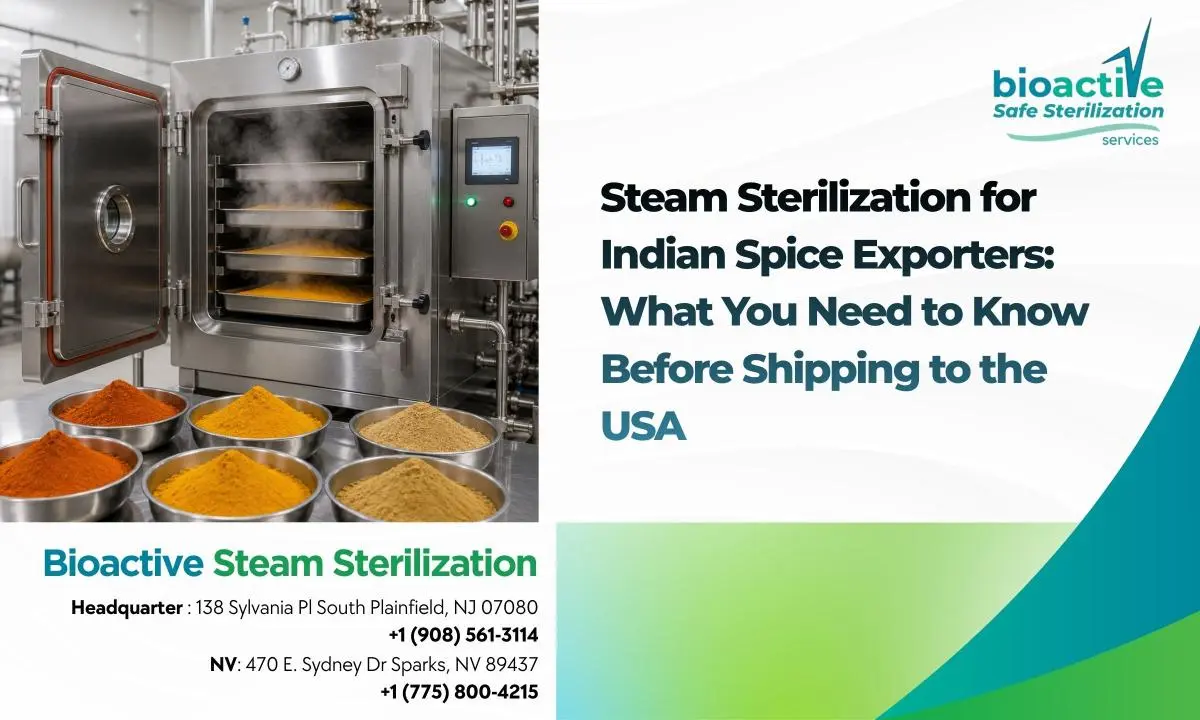
Steam Sterilization for Indian Spice Exporters: What You Need to Know Before Shipping to the USA
Indian spices are widely used by food manufacturers, nutraceutical companies, and brands across the United States. However, exporting spices from India to the USA requires more than maintaining product quality during manufacturing. Indian spice exporters must also address microbial safety, pathogen reduction, food safety requirements, and buyer specifications before their ingredients enter the U.S. supply chain.
This is where steam sterilization for Indian spice exporters can play an important role.
A validated steam sterilization process can help reduce harmful microorganisms while preserving the natural aroma, color, flavor, and quality of spices. For Indian exporters shipping ingredients to the USA, working with a USA-based steam sterilization facility can also simplify post-import processing and support U.S. food safety and regulatory requirements.
Why Steam Sterilization Matters for Indian Spice Exporters
Spices and herbs can be exposed to microbial contamination at several stages, including harvesting, drying, transportation, storage, processing, and handling.
Common microbial concerns include:
- Salmonella
- E. coli
- Yeast
- Mold
- High Total Plate Count (TPC)
For Indian exporters supplying the U.S. market, controlling these risks is essential because buyers increasingly expect consistent microbial quality and documented pathogen reduction.
Steam sterilization provides a natural microbial reduction process using heat and steam rather than chemical treatments or irradiation.
USA-based steam sterilization services can provide Indian exporters with a controlled processing step for India-origin spices, herbs, nutraceutical ingredients, and other food ingredients. The process is designed to support pathogen reduction while maintaining ingredient integrity.
What Is Steam Sterilization for Indian Spice Exporters?
Steam sterilization is a controlled microbial reduction process in which ingredients are exposed to carefully managed heat and steam.
The objective is to reduce harmful pathogens and microbial loads while maintaining the characteristics of the ingredient.
For Indian spice exporters, steam sterilization can be used for ingredients such as:
- Turmeric
- Black pepper
- Chili powder
- Cumin
- Coriander
- Cardamom
- Herbal powders
- Other spice
A USA-based steam sterilization process can use continuous natural steam sterilization with heat, steam, and flash-cooling steps. The process is designed to target pathogens including Salmonella, E. coli, yeast, and mold.
Why Use a USA-Based Steam Sterilization Facility?
Indian exporters have traditionally handled most processing before products leave India. However, a U.S.-based processing model can provide an additional step between the arrival of India-origin ingredients and their distribution to U.S. buyers.
Bioactive Safe Sterile or Steam Sterilization provides USA-based processing solutions for India-origin ingredients, including steam sterilization services designed for Indian exporters.
A USA-based steam sterilization facility can help Indian exporters with:
- Steam sterilization
- Microbial reduction
- Pathogen reduction
- Toll processing
- Toll blending
- Milling
- Packaging and repackaging
- Microbial load testing
- Batch-level documentation
- Final quality checks
This creates a connected processing model for exporters that need their ingredients processed in the United States.
How Steam Sterilization Helps Meet U.S. Food Safety Requirements
The U.S. food industry follows strict food safety requirements. Imported ingredients must meet applicable food safety and regulatory expectations before they are distributed to U.S. buyers.
USA-based steam sterilization services can support Indian exporters by providing a controlled microbial reduction step as part of their overall processing and food safety strategy.
Steam sterilization can help:
- Reduce microbial contamination
- Support pathogen reduction
- Improve buyer confidence
- Provide batch-level sterilization documentation
- Support compliance-ready processing
- Reduce the risk associated with microbial quality issues
Importantly, sterilization is one component of an overall food safety and compliance program. Exporters should ensure that all applicable import, documentation, supplier verification, and regulatory requirements are addressed for their products.
What Does 5-Log Pathogen Reduction Mean?
One of the key terms associated with validated steam sterilization is 5-log pathogen reduction.
A 5-log reduction represents a 99.999% reduction in the targeted microbial population under the validated treatment conditions.
A validated steam sterilization process can achieve greater than 5-log microbial and pathogen reduction when appropriate treatment parameters are established and verified.
For Indian spice exporters, validated pathogen reduction can provide important documentation when working with U.S. buyers that have specific microbial requirements.
What Happens During the Steam Sterilization Process?
A controlled steam sterilization process involves carefully managing treatment conditions to achieve the required microbial reduction.
The process can include:
1. Product Receiving
India-origin ingredients arrive at the U.S.-based processing facility.
The product is received and handled according to established processing and quality procedures.
2. Microbial Assessment
Microbial load testing can be used to understand the condition of the product before treatment.
Depending on the ingredient and specification, testing may include microbial parameters such as:
- Salmonella
- Total Plate Count
- Yeast and mold
- Other pathogen detection
3. Validated Steam Treatment
The ingredient undergoes controlled steam treatment designed to achieve the required microbial reduction.
A continuous natural steam sterilization process can use heat and steam followed by flash-cooling steps.
4. Cooling and Handling
After treatment, the product is handled through controlled processing steps to maintain its quality and reduce the risk of recontamination.
5. Final Quality Checks
Inline controls can include:
- Microbial load testing
- Sifting
- Magnetic separation
- Metal detection
- Final validation before packaging
6. Documentation and Packaging
Following processing, batch-level documentation and sterilization certification can support buyer and compliance requirements.
The product can then move into packaging or additional processing where required.
Does Steam Sterilization Affect Spice Quality?
Indian spice exporters are often concerned about whether microbial treatment can affect the natural characteristics of their products.
A properly validated steam sterilization process is designed to achieve microbial reduction while maintaining important ingredient characteristics.
Steam sterilization can be designed to preserve:
- Natural aroma
- Color
- Flavor
- Bioactivity
- Nutritional characteristics
The process also avoids chemical residues and irradiation.
This makes steam sterilization services particularly relevant for exporters supplying organic ingredients and clean-label products.
Is Steam Sterilization Suitable for Organic Spices?
Steam sterilization can be suitable for organic ingredients because it uses heat and steam rather than chemical fumigation or irradiation.
For Indian exporters of organic spices, herbs it is important to work with a steam sterilization facility that understands organic handling requirements and maintains appropriate segregation and documentation.
A suitable processing facility can help exporters maintain the integrity of organic ingredients while addressing microbial reduction requirements.
What Other Processing Services May Indian Spice Exporters Need?
Steam sterilization is not always the only processing requirement.
Depending on the product and buyer specification, Indian exporters may also require additional toll processing services.
Toll Blending
Toll blending allows sterilized ingredients to be combined according to specific formulations or blending protocols.
Bioactive Safe Sterile or Steam Sterilization provides custom toll blending with controlled processing environments and batch-to-batch consistency.
Milling
Some exporters require precision milling after or alongside other processing steps.
Milling can help achieve:
- Consistent particle size
- Improved solubility
- Optimized texture
USA-based processing services can accommodate powders, whole ingredients, leaves, slices, crushed, and chopped forms.
Packaging and Repackaging
After steam sterilization, appropriate packaging helps protect the processed ingredient during storage and distribution.
Packaging options can include:
- Jar filling
- Pouch packaging
- Export-ready bulk formats
- Regulatory-compliant labeling and handling
Packaging and repackaging services can provide Indian exporters with additional flexibility when preparing ingredients for U.S. buyers.
Why Indian Exporters May Prefer One U.S. Processing Partner
Using separate companies for sterilization, milling, blending, testing, and packaging can create additional handling and coordination requirements.
A U.S.-based toll processing partner that combines multiple services can simplify the supply chain.
For Indian exporters, a connected processing model can provide access to:
Receiving → Testing → Steam Sterilization → Milling/Blending → Quality Checks → Packaging
Bioactive Safe Sterile or Steam Sterilization provides processing capabilities that include steam sterilization, toll blending, milling, packaging, and microbial testing, allowing exporters to manage multiple processing requirements through one U.S.-based partner.
This can help exporters maintain better continuity between processing stages and documentation.
Who Can Benefit From USA Steam Sterilization Services?
USA-based steam sterilization services can be relevant to several types of Indian exporters, including:
Spice Manufacturers & Exporters
Companies exporting turmeric, pepper, chili, cumin, coriander, cardamom, and other spices can use microbial reduction processing to support U.S. buyer requirements.
Herbal Ingredient Suppliers
Herbs and plant-based ingredients can require microbial control while maintaining their natural characteristics.
Nutraceutical Ingredient Suppliers
Nutraceutical ingredients may require controlled microbial reduction and documentation before distribution to U.S. manufacturers and brands.
Organic Powder Producers
Organic ingredient suppliers can benefit from chemical-free steam processing that aligns with organic and clean-label requirements.
Food Ingredient Manufacturers
Food ingredient manufacturers supplying U.S. buyers can use U.S.-based toll processing for sterilization, milling, blending, and packaging.
What Should Indian Spice Exporters Check Before Choosing a Sterilization Partner?
Before selecting a USA steam sterilization partner, Indian exporters should evaluate several factors.
1. Validated Sterilization Process
Ask whether the facility has validated its steam sterilization process and can provide appropriate validation documentation.
2. Microbial Testing
Confirm whether pre- and post-treatment microbial testing is available and whether third-party laboratory verification can be supported.
3. 5-Log Reduction Capability
If required by the buyer, confirm whether the processor can demonstrate validated 5-log pathogen reduction for the relevant product and process.
4. Regulatory Compliance
Review the facility’s applicable FDA, GMP, FSMA/FSVP, and organic handling systems.
5. Product Experience
A processor should understand the characteristics of spices, herbs and nutraceutical ingredients.
6. Downstream Processing
If you also need milling, toll blending, or packaging, using a facility that offers these services can simplify your supply chain.
7. Batch Documentation
Ask about sterilization certificates, microbial test reports, traceability, and other batch-level documentation required by your U.S. buyers.
Frequently Asked Questions
What is steam sterilization for Indian spice exporters?
Steam sterilization is a controlled microbial reduction process using heat and steam to reduce harmful microorganisms in spices and herbs. It can help Indian exporters address microbial safety and U.S. buyer requirements.
Which Indian spices can undergo steam sterilization?
Common products include turmeric, black pepper, chili powder, cumin, coriander, cardamom, and other spice. Treatment requirements depend on the product and validated process.
Why do Indian spice exporters need steam sterilization?
Steam sterilization can help reduce microbial contamination and pathogens, support food safety requirements, and provide documented microbial reduction for U.S. buyers.
Does steam sterilization use chemicals?
Steam sterilization uses heat and steam rather than chemical treatments or irradiation. This makes it a suitable microbial reduction approach for many food ingredients.
Can steam sterilization support organic spice exports?
Yes. Steam sterilization can be suitable for organic and clean-label ingredients when processed under appropriate organic handling requirements.
What is 5-log pathogen reduction?
A 5-log reduction represents a 99.999% reduction in the targeted microbial population under validated treatment conditions.
Can Indian exporters get packaging after sterilization?
Yes. Packaging and repackaging services can be provided after steam sterilization, including jar filling, pouch packaging, and export-ready bulk formats.
Can steam sterilization be combined with milling and blending?
Yes. U.S.-based toll processing services can combine steam sterilization, milling, toll blending, microbial testing, and packaging, allowing exporters to manage multiple processing requirements through one processing partner.
Conclusion
For Indian spice exporters, successfully entering the U.S. market requires more than shipping a high-quality product. Microbial safety, pathogen reduction, validated processing, documentation, and buyer requirements all play an important role in preparing India-origin ingredients for the U.S. supply chain.
Steam sterilization for Indian spice exporters provides a natural approach to microbial reduction while supporting the preservation of aroma, color, flavor, and ingredient quality.
A USA-based steam sterilization and toll processing facility can provide additional support through microbial testing, validated pathogen reduction, toll blending, milling, packaging, and batch-level documentation.
For Indian exporters of spices, herbs, nutraceutical ingredients, organic powders, and food ingredients, choosing the right U.S. processing partner can help create a more streamlined path from India-origin manufacturing to U.S.-market-ready ingredients.