
-
admin
- August 25, 2026
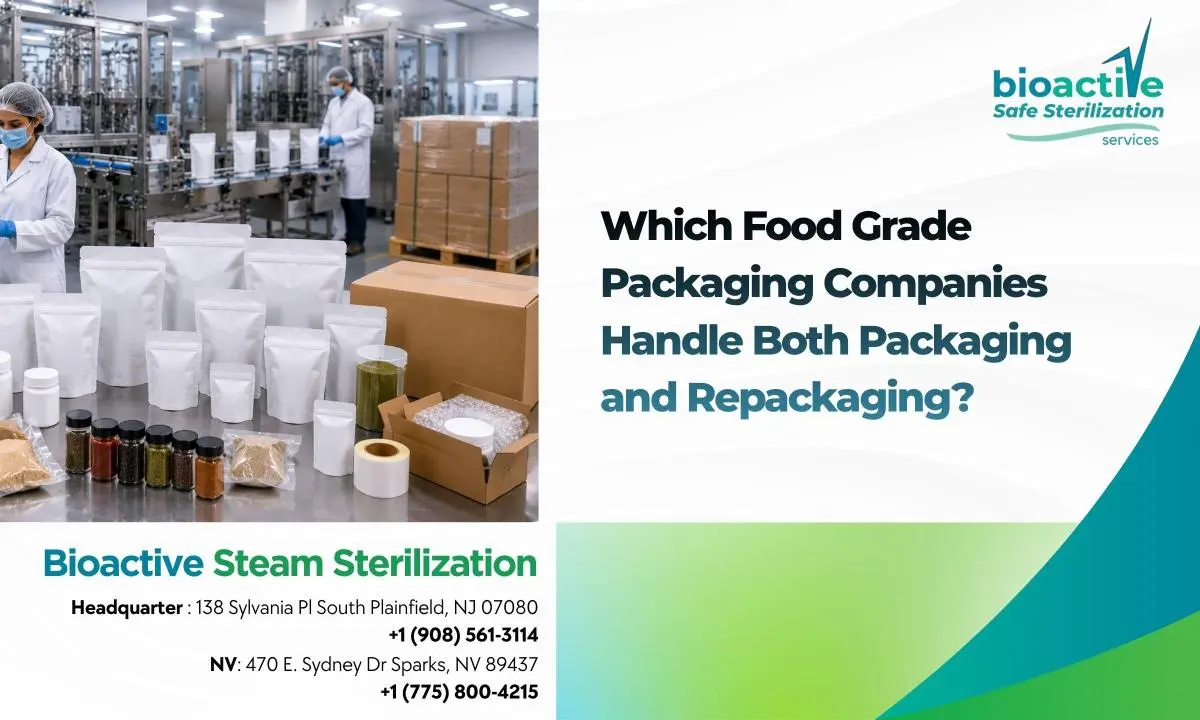
Which Food Grade Packaging Companies Handle Both Packaging and Repackaging?
Food manufacturers, ingredient suppliers, nutraceutical companies, spice exporters, and distributors often purchase ingredients in bulk but require them in different packaging formats or quantities for manufacturing, storage, distribution, or customer delivery.
This creates an important question: Which food grade packaging companies handle both packaging and repackaging?
The right partner should be able to do more than fill containers. For many food ingredient businesses, packaging and repackaging may need to be coordinated with other processing requirements such as steam sterilization, milling, blending, sieving, sifting, or quality testing.
Bioactive Safe Sterile or Steam Sterilization provides bulk ingredient packaging and repackaging services in the USA as part of its broader ingredient processing capabilities. Its packaging services can be combined with steam sterilization, milling, toll blending, magnetic separation, and other processing requirements, allowing businesses to coordinate multiple stages with one processing partner.
What Are Food Grade Packaging and Repackaging Services?
Food grade packaging involves placing food ingredients or processed materials into appropriate packaging formats designed for handling, storage, transportation, manufacturing, or distribution.
Repackaging involves transferring ingredients from one bulk or existing packaging format into another package size or format according to customer requirements.
For example, a food ingredient supplier may receive an ingredient in a large bulk container but need the material divided into smaller quantities for different customers.
A typical requirement could involve:
Bulk Ingredient → Processing → Quality Checks → Packaging/Repackaging → Shipment
Packaging and repackaging may include:
- Pouch packaging
- Jar filling
- Bulk packaging
- Customer-specific packaging
- Export-ready packaging
- Palletizing and shipment preparation
The exact packaging format depends on the ingredient, quantity, storage requirements, transportation conditions, and customer specifications.
Why Do Businesses Need Both Packaging and Repackaging Services?
Food ingredient companies may have different packaging requirements at different stages of their supply chain.
A manufacturer may purchase an ingredient in bulk for internal production, while a distributor may need the same ingredient in smaller customer-specific quantities.
Having access to both packaging and repackaging capabilities provides greater flexibility.
Flexible Packaging Quantities
Different customers may require different package sizes.
For example, an ingredient supplier may need:
- Large bulk packages for manufacturers
- Medium-sized packages for distributors
- Smaller packages for specific commercial applications
A repackaging partner can help convert bulk materials into the required quantities.
Simplified Supply Chain
When packaging is provided by the same company handling other ingredient processing requirements, businesses may not need to coordinate multiple third-party facilities.
This can simplify scheduling, transportation, documentation, and project coordination.
Reduced Product Handling
Moving ingredients between multiple facilities creates additional transportation and handling requirements.
An integrated processing and packaging partner can reduce unnecessary movement between vendors. Bioactive’s service model combines packaging with processing capabilities such as sterilization, milling, blending, and sifting.
What Should You Look for in a Food Grade Packaging Company?
Not every packaging company is equipped to handle bulk food ingredients.
When selecting a food grade packaging and repackaging company, businesses should evaluate several factors.
1. Experience With Food Ingredients
The company should understand the handling requirements associated with food ingredients, powders, spices, herbs, nutraceutical materials, and other dry ingredients.
2. Packaging Flexibility
A suitable partner should be able to accommodate the required packaging format and quantity.
The requirements can vary significantly depending on whether the ingredient is being supplied to another manufacturer, distributor, warehouse, or retail-oriented operation.
3. Additional Processing Capabilities
Packaging may not always be the only requirement.
An ingredient could require:
- Steam sterilization
- Milling
- Grinding
- Sieving
- Sifting
- Magnetic separation
- Toll blending
- Delumping
Using a company that offers several of these capabilities can simplify the overall processing workflow. Bioactive Safe Sterile or Steam Sterilization lists these services alongside packaging and repackaging.
4. Quality and Traceability
Food ingredient companies should consider the provider’s quality systems, testing capabilities, lot identification, and traceability procedures.
Traceability can be particularly important when ingredients are being processed, repackaged, and distributed to multiple customers.
5. Facility Location
For businesses distributing ingredients throughout the USA, facility location can influence transportation time and logistics.
Bioactive Safe Sterile or Steam Sterilization operates facilities in South Plainfield, New Jersey, and Sparks, Nevada, supporting its U.S. processing operations.
Which Ingredients Can Be Packaged and Repackaged?
Food grade packaging and repackaging services can be relevant to a broad range of dry ingredients.
Depending on the processing and packaging requirements, applications may include:
- Spices and seasonings
- Herbs
- Nutraceutical ingredients
- Functional food ingredients
These services can be particularly relevant to food ingredient manufacturers, spice manufacturers, exporters, nutraceutical companies, dietary supplement companies, organic ingredient suppliers, distributors, and international exporters.
Can Packaging and Repackaging Be Combined With Ingredient Processing?
Yes.
One of the advantages of working with an integrated ingredient processing company is that packaging does not necessarily have to be treated as a separate stage.
For example, a project may follow a workflow such as:
Bulk Ingredient Receiving
↓
Steam Sterilization
↓
Milling / Grinding
↓
Sieving / Sifting
↓
Magnetic Separation
↓
Toll Blending
↓
Packaging / Repackaging
↓
Quality Checks
↓
Finished Product Shipment
The actual workflow depends on the ingredient and the customer’s specifications.
This approach can be useful when an ingredient needs processing before it is placed into its final packaging format.
Food Grade Packaging After Steam Sterilization
Some food ingredients may require microbial reduction before packaging.
Bioactive Safe Sterile or Steam Sterilization provides a steam sterilization process designed to achieve a validated minimum 5-log reduction in microbial load. The company states that its process uses steam rather than chemicals or radiation and is designed to preserve important ingredient characteristics such as color, aroma, flavor, and nutritional quality.
After sterilization, ingredients may require additional processing such as milling, sieving, blending, or magnetic separation before packaging.
Combining these stages can reduce unnecessary movement of ingredients between different processing facilities.
How Does Food Ingredient Repackaging Work?
Although the exact process depends on the product and packaging requirements, a typical repackaging workflow can include the following steps.
Step 1: Ingredient Receiving
Bulk ingredients are received and identified according to the applicable product and lot information.
Step 2: Processing Review
The customer’s processing and packaging specifications are reviewed.
If required, the ingredient may undergo sterilization, milling, blending, sieving, sifting, or magnetic separation.
Step 3: Packaging Preparation
The required packaging format, package size, container, liner, and labeling specifications are prepared.
Step 4: Weighing and Filling
The ingredient is weighed and transferred into the specified package.
Step 5: Sealing
The package is sealed or closed according to the selected packaging format.
Step 6: Identification and Traceability
Applicable product, lot, batch, and packaging information can be maintained to support traceability.
Step 7: Quality Checks
Relevant quality and safety checks may be performed before finished packages are released.
Step 8: Palletizing and Shipment
The finished packages can then be prepared for storage, transportation, or customer shipment.
Packaging and Repackaging for Spices and Herbs
Spices and herbs are important applications for specialized ingredient processing and packaging.
Ingredients such as turmeric, chili, herbs, teas, and other dry materials may require microbial control, particle-size management, separation, and appropriate packaging before being supplied to food or nutraceutical manufacturers.
An integrated provider can coordinate multiple processing requirements before the ingredient reaches its final packaging stage.
For spice manufacturers and exporters, this can help simplify the transition from bulk ingredients to processed and packaged materials.
Packaging and Repackaging for Nutraceutical Ingredients
Nutraceutical manufacturers often work with ingredients such as proteins, functional ingredients, herbs, and other dry materials.
Packaging requirements may vary depending on where the ingredient is going next.
For example, an ingredient may be packaged for:
- Another manufacturer
- A blending facility
- A supplement production facility
- A distributor
- A warehouse
- A commercial customer
Flexible packaging and repackaging capabilities can therefore help ingredient suppliers serve different customers without establishing separate packaging operations.
Why Use One Company for Packaging and Repackaging?
Using a single ingredient processing partner for multiple stages can provide several operational advantages.
Fewer Vendors to Coordinate
A company may be able to coordinate sterilization, milling, blending, sifting, and packaging through one provider rather than managing several suppliers.
Reduced Transportation Between Facilities
Fewer transfers can mean less movement of ingredients between different processing locations.
Simplified Project Management
A single processing partner can make it easier to coordinate specifications, timelines, packaging requirements, and documentation.
Access to Multiple Processing Services
If an ingredient requires processing before packaging, an integrated provider can potentially handle those requirements within the same workflow.
Support for International Supply Chains
U.S.-based packaging and processing can be particularly useful for international ingredient suppliers serving American manufacturers, distributors, and brands.
Why Choose Bioactive Safe Sterile or Steam Sterilization for Food Grade Packaging and Repackaging?
Bioactive Safe Sterile or Steam Sterilization positions itself as an ingredient processing and toll processing partner rather than only a packaging provider.
Its capabilities include:
- Steam sterilization
- Milling and grinding
- Toll blending
- Powder sieving and sifting
- Magnetic separation
- Delumping
- Packaging
- Repackaging
- Microbiological analysis
- Pathogen analysis
- Quality assurance testing
This broader service offering can be useful for companies that need packaging together with other ingredient processing requirements.
For example, a spice manufacturer may need an ingredient to be steam sterilized, milled to a specific particle size, screened, and then packaged into bulk quantities.
Rather than coordinating each stage with a separate supplier, the manufacturer can work with one ingredient-processing partner.
Who Can Benefit From Food Grade Packaging and Repackaging Services?
These services can support several industries and business types.
Food and Beverage Manufacturers
Food companies can use packaging and repackaging services for spices, flours, pulses, functional ingredients, and other dry materials.
Nutraceutical Companies
Nutraceutical and dietary supplement manufacturers may require packaging for functional ingredients, proteins, herbs, and other materials.
Spice and Seasoning Companies
Spice manufacturers and exporters can combine ingredient processing with packaging and repackaging requirements.
Ingredient Distributors
Distributors may purchase ingredients in bulk and need them repackaged into customer-specific quantities.
Organic Ingredient Suppliers
Organic ingredient businesses may require appropriate processing and packaging support for their ingredient supply chains.
International Exporters
International suppliers shipping ingredients into the United States may benefit from U.S.-based processing, packaging, and repackaging capabilities.
How to Choose the Right Food Grade Packaging and Repackaging Partner
Before selecting a packaging company, ask the following questions:
Does the company handle my ingredient type?
Confirm that the provider has experience with the ingredient category and physical form involved.
Can it handle my required packaging quantity?
Check whether the company can accommodate your required package weight, format, and production volume.
Can it provide additional processing?
If the ingredient requires sterilization, milling, blending, sieving, or separation, an integrated provider may be more convenient.
Does it have suitable quality systems?
Review available certifications, quality programs, testing capabilities, and facility standards.
Can it support traceability?
Ask how product, lot, batch, and packaging information are managed.
Does it support U.S. and international supply chains?
For exporters, determine whether the provider can support the requirements associated with supplying ingredients into the U.S. market.
Where are its facilities located?
Facility locations can affect transportation planning and overall supply chain efficiency.
Frequently Asked Questions
Which food grade packaging companies handle both packaging and repackaging?
Food ingredient processing companies that provide integrated packaging services may handle both bulk packaging and repackaging. Bioactive Safe Sterile or Steam Sterilization provides packaging and repackaging as part of its broader ingredient processing capabilities in the USA.
What is the difference between food packaging and food repackaging?
Food packaging generally involves placing an ingredient or product into its required packaging. Repackaging involves transferring bulk or previously packaged material into a different package size or format.
Can bulk food ingredients be repackaged into smaller quantities?
Yes. Repackaging services can transfer bulk ingredients into specified package sizes according to customer and product requirements. The available quantities and formats depend on the project specifications.
Can food ingredients be sterilized before packaging?
Yes. Where applicable, ingredients can undergo processing such as steam sterilization before packaging. Bioactive Safe Sterile or Steam Sterilization provides steam sterilization alongside its packaging and other ingredient processing services.
Can ingredients be milled or blended before packaging?
Yes. Milling, blending, sieving, sifting, and other processing requirements can be combined with packaging depending on the ingredient and project specifications.
Where does Bioactive Safe Sterile or Steam Sterilization provide food ingredient packaging services?
Bioactive Safe Sterile or Steam Sterilization operates processing facilities in South Plainfield, New Jersey, and Sparks, Nevada, supporting customers across the United States.
Why should businesses use one company for ingredient processing and packaging?
Using one processing partner can simplify project coordination, reduce transportation between multiple vendors, minimize unnecessary handling, and create a more streamlined workflow from bulk ingredient to finished packaged material.
Conclusion
Choosing a food grade packaging company that can handle both packaging and repackaging can help food ingredient manufacturers, nutraceutical companies, spice suppliers, distributors, and exporters simplify their supply chains.
The right partner should provide more than packaging alone. Businesses should consider ingredient-handling experience, packaging flexibility, processing capabilities, quality systems, traceability, facility locations, and the ability to support their specific supply-chain requirements.
Bioactive Safe Sterile or Steam Sterilization combines food grade packaging and repackaging with ingredient processing capabilities including steam sterilization, milling, toll blending, sieving, magnetic separation, and quality testing.
With facilities in New Jersey and Nevada, Bioactive Safe Sterile or Steam Sterilization can support U.S. manufacturers, ingredient suppliers, distributors, and international exporters looking for an integrated food ingredient processing and packaging partner.
If you need food grade packaging and repackaging services in the USA, Bioactive Safe Sterile or Steam Sterilization can evaluate your ingredient, processing requirements, packaging format, quantity, and application to develop an appropriate solution.