
-
admin
- July 13, 2026
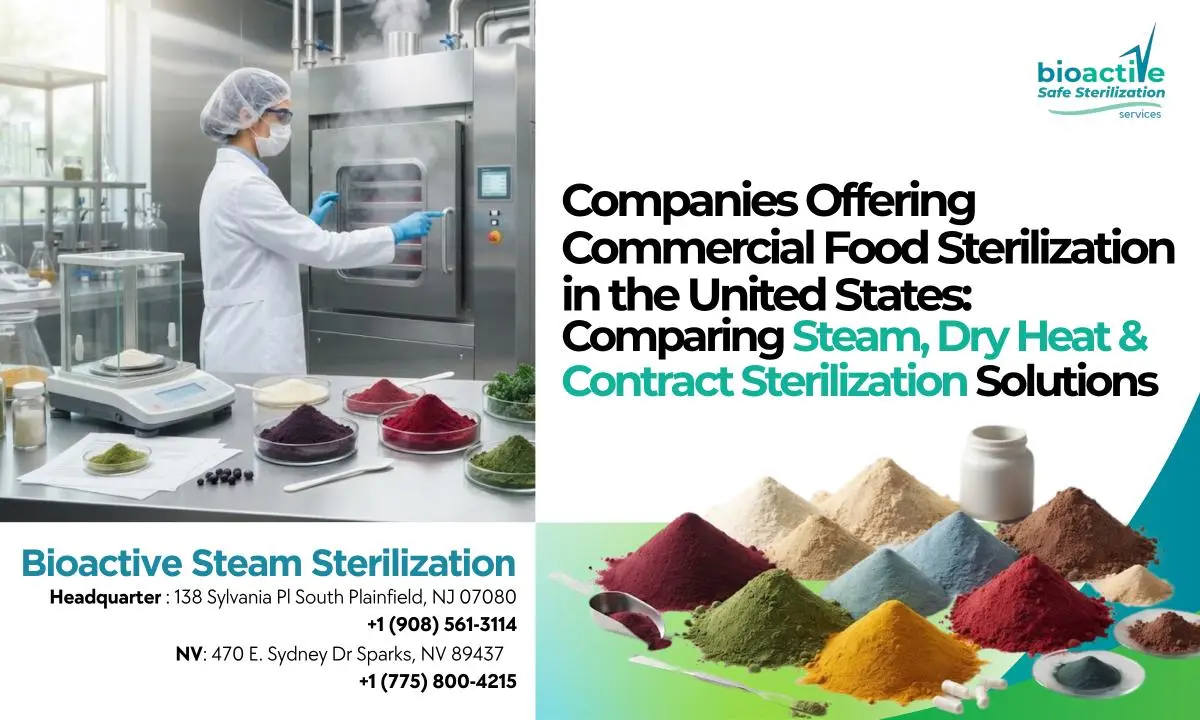
Companies Offering Commercial Food Sterilization in the United States: Comparing Steam, Dry Heat & Contract Sterilization Solutions
As food safety regulations become more rigorous and consumer expectations continue to evolve, manufacturers of powdered ingredients must ensure that their products meet increasingly demanding microbial safety standards. Whether producing spices, herbs, nutraceutical ingredients, botanical extracts, protein powders, or specialty formulations, effective microbial reduction is essential for protecting consumers and maintaining regulatory compliance.
This growing need has led many companies to work with companies offering commercial food sterilization in the United States that provide validated pathogen reduction, steam sterilization, toll processing, blending, formulation, and packaging services.
At Bioactive Services, we specialize in helping manufacturers improve food safety through commercial steam sterilization while offering integrated manufacturing solutions that simplify production from raw ingredient to finished packaged product.
This guide compares steam sterilization, dry heat processing, and contract sterilization services so manufacturers can select the right solution for their products and operational goals.
Understanding Commercial Food Sterilization
What Is Commercial Food Sterilization?
Commercial food sterilization refers to validated processes designed to significantly reduce microorganisms in food ingredients before they are incorporated into finished products. Unlike household cooking, these industrial processes are carefully controlled, monitored, and documented to achieve consistent microbial reduction while preserving ingredient functionality.
For powdered ingredients, commercial sterilization plays an important role in reducing microbial loads that may be introduced during harvesting, drying, transportation, or storage.
Why Food Manufacturers Outsource Sterilization
Rather than investing in expensive in-house sterilization equipment, many manufacturers rely on contract processors that specialize in microbial reduction. Outsourcing provides access to advanced technology, experienced personnel, validated processes, and scalable production capacity without the capital expense of building dedicated facilities.
Industries That Require Sterilization Services
Commercial sterilization is widely used across multiple sectors, including:
- Food manufacturing
- Nutraceutical production
- Botanical processing
- Functional foods
- Dietary supplements
- Beverage ingredients
- Life sciences
- Ingredient suppliers
- Contract manufacturers
Major Commercial Sterilization Technologies
Steam Sterilization
Steam sterilization uses precisely controlled heat and moisture to reduce microbial populations in powdered ingredients.
This technology is commonly selected for:
- Spices
- Herbs
- Botanical ingredients
- Nutraceutical powders
- Functional food ingredients
- Protein powders
Properly validated steam sterilization can achieve substantial microbial reduction while preserving flavor, aroma, color, and functional properties.
Dry Heat Sterilization
Dry heat sterilization relies on elevated temperatures without moisture.
Potential benefits include:
- Simpler processing for some applications
- No added moisture
However, dry heat often requires higher temperatures and longer processing times, which may affect sensitive ingredients and increase the likelihood of changes to flavor, color, or functionality.
Contract Sterilization Services
Contract sterilization providers offer outsourced microbial reduction using specialized equipment and validated processes. In addition to sterilization, many providers also deliver complementary services such as:
- Toll blending
- Milling
- Screening
- Packaging
- Quality testing
- Logistics support
Working with a contract processor enables manufacturers to streamline production and reduce operational complexity.
Other Microbial Reduction Technologies
Alternative methods such as irradiation or other specialized technologies may also be used depending on ingredient type, customer requirements, and regulatory considerations. The most appropriate method depends on product characteristics, quality objectives, and market expectations.
Steam Sterilization vs. Dry Heat: Which Is Better?
Microbial Reduction Performance
Steam sterilization is widely recognized for efficient heat transfer and effective microbial reduction in powdered ingredients. Properly validated systems can support significant pathogen reduction targets while maintaining product integrity.
Dry heat can also reduce microorganisms but may require more aggressive processing conditions for equivalent results.
Product Quality Preservation
Maintaining ingredient quality is critical for manufacturers.
Steam sterilization is often preferred because it helps preserve:
- Flavor
- Aroma
- Color
- Nutritional value
- Functional characteristics
Dry heat processing may have a greater impact on heat-sensitive ingredients due to longer exposure times.
Processing Time
Steam sterilization generally achieves microbial reduction more efficiently because moisture enhances heat transfer. Dry heat processes may require longer treatment cycles to reach the desired level of microbial inactivation.
Regulatory Acceptance
Validated steam sterilization processes are widely accepted as part of preventive food safety programs. Providers should maintain documentation, monitoring records, and validation data to support customer audits and compliance initiatives.
Environmental Considerations
Steam sterilization avoids chemical treatments and is compatible with many clean-label and organic processing objectives. It also integrates well into sustainable manufacturing strategies by reducing reliance on chemical interventions.
Why Contract Sterilization Is Growing
Cost Advantages
Outsourcing eliminates the need for large capital investments in sterilization equipment and infrastructure.
Faster Production
Established contract processors can often accelerate production by providing ready-to-use facilities, trained personnel, and validated processes.
Reduced Capital Investment
Manufacturers can allocate resources to product development, marketing, and business growth rather than investing in specialized processing equipment.
Scalability
Contract sterilization partners support pilot runs, commercial production, and expanding manufacturing volumes as business needs evolve.
Choosing a Commercial Food Sterilization Provider
Validation Capabilities
Look for providers that can demonstrate validated microbial reduction processes supported by scientific data and robust quality systems.
Processing Experience
Experience with powdered ingredients, spices, herbs, nutraceuticals, and botanical materials helps ensure consistent product quality and efficient processing.
Regulatory Documentation
Comprehensive documentation—including batch records, process monitoring, validation reports, and traceability—supports customer audits and regulatory compliance.
Integrated Manufacturing Services
Manufacturers increasingly benefit from partners that combine sterilization with:
- Toll blending
- Custom formulation
- Packaging
- Ingredient sourcing support
- Logistics coordination
An integrated approach reduces handling, improves efficiency, and simplifies the supply chain.
Why Bioactive Services Is Different
At Bioactive Services, we provide comprehensive manufacturing solutions that extend beyond sterilization.
Commercial Steam Sterilization
Our advanced steam sterilization systems are designed for powdered food ingredients, herbs, spices, nutraceuticals, and botanical products, supporting effective microbial reduction while maintaining ingredient quality.
5-Log Pathogen Reduction
We develop validated processing programs that help customers achieve meaningful microbial reduction targets appropriate for their products and food safety plans.
Toll Blending
Our precision toll blending services deliver consistent batch uniformity for custom powdered formulations.
Custom Formulation
We assist with formulation development, process optimization, and scale-up to support successful commercialization.
Packaging
Flexible packaging solutions protect product integrity and streamline distribution.
Complete Manufacturing Support
By integrating sterilization, blending, formulation, packaging, and quality support under one roof, Bioactive Services helps manufacturers reduce complexity, improve efficiency, and accelerate time to market.
Frequently Asked Questions
What is commercial food sterilization?
Commercial food sterilization is a validated industrial process that reduces microorganisms in food ingredients to improve safety, quality, and regulatory compliance.
What is the difference between steam sterilization and dry heat?
Steam sterilization uses controlled heat and moisture, while dry heat relies solely on elevated temperatures. Steam is often preferred for powdered ingredients because it provides efficient microbial reduction while helping preserve product quality.
Why do manufacturers use contract sterilization services?
Contract sterilization allows manufacturers to access specialized equipment, validated processes, and experienced personnel without investing in in-house facilities.
What products commonly undergo steam sterilization?
Common applications include spices, herbs, botanical powders, nutraceutical ingredients, protein powders, functional food ingredients, and specialty formulations.
Does Bioactive Services provide additional manufacturing support?
Yes. Bioactive Services offers commercial steam sterilization, pathogen reduction, toll blending, custom formulation, packaging, and integrated production support.