
-
admin
- September 21, 2026
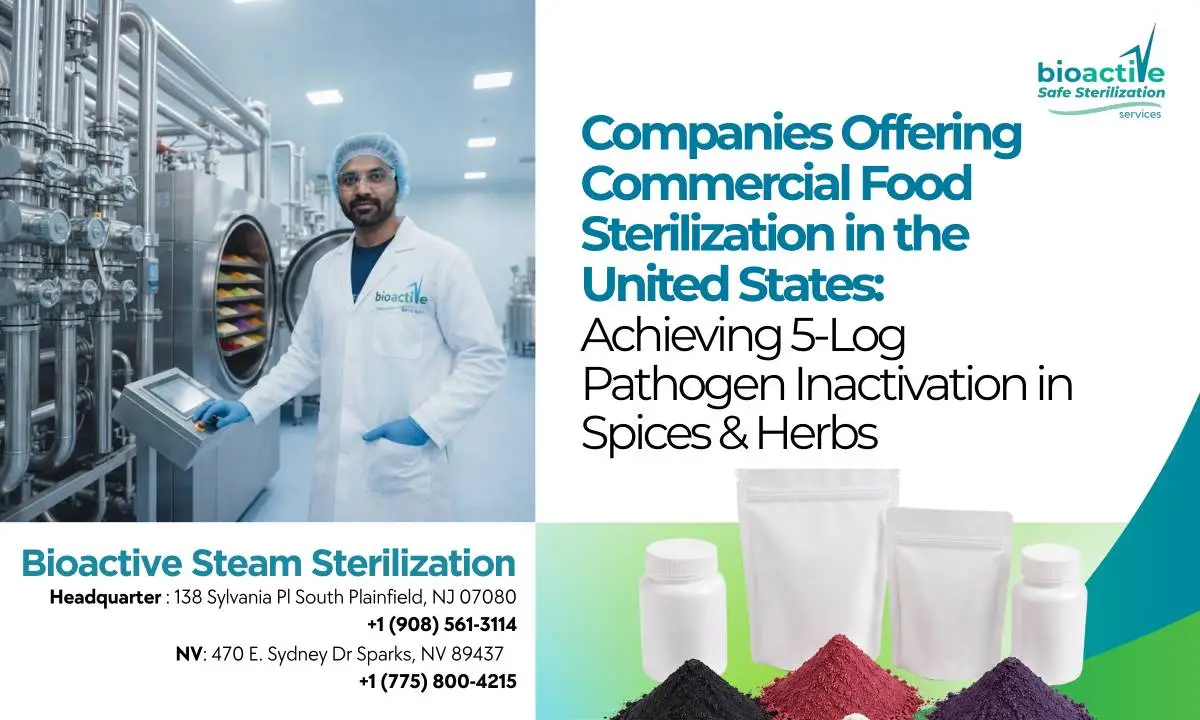
Companies Offering Commercial Food Sterilization in the United States: Achieving 5-Log Pathogen Inactivation in Spices & Herbs
Introduction: Commercial Food Sterilization for Spices and Herbs
Spices and herbs are essential ingredients across food, beverage, nutraceutical, and functional-product manufacturing. Yet their agricultural origins can make microbial control an important consideration for manufacturers purchasing and processing these ingredients.
For companies sourcing spices and herbs in the United States, the challenge is not simply finding a processor that can apply heat. Manufacturers need to understand whether a commercial processing partner can deliver a controlled microbial-reduction process while maintaining the quality and functional characteristics of the ingredient.
This is where companies offering commercial food sterilization in the United States can play an important role.
At Bioactive Services, we work with manufacturers seeking practical solutions for microbial reduction in powdered and dry ingredients. Our approach combines commercial steam processing with an understanding of the broader requirements associated with food ingredients, spices, herbs, nutraceuticals, blending, formulation, and packaging.
A 5-log reduction can represent a significant microbial-reduction objective. However, achieving that objective must be considered in relation to the specific product, target microorganism, processing conditions, and validation strategy.
In this guide, we explain what manufacturers should know about commercial food sterilization, 5-log pathogen inactivation, steam treatment for spices and herbs, and how to select the right U.S. processing partner.
What Is 5-Log Pathogen Inactivation?
Understanding Log Reduction in Food Safety
Log reduction is a way of describing the decrease in a microbial population following a treatment process.
The relationship is commonly expressed as:
Log Reduction | Approximate Reduction |
1-log | 90% |
2-log | 99% |
3-log | 99.9% |
4-log | 99.99% |
5-log | 99.999% |
A 5-log reduction represents a 99.999% reduction in the targeted microbial population under defined processing conditions.
This terminology is particularly important when manufacturers discuss commercial pathogen reduction because it describes the degree of reduction rather than guaranteeing absolute sterility.
What Does 5-Log Pathogen Inactivation Mean?
Consider an example starting population of 1,000,000 microorganisms.
A 5-log reduction would theoretically reduce the population by 99.999%, leaving approximately 10 organisms.
The actual effectiveness of a process depends on variables such as:
- Target organism
- Initial microbial population
- Ingredient composition
- Moisture
- Temperature
- Treatment time
- Particle characteristics
- Processing configuration
- Desired microbial reduction
Therefore, a 5-log objective should be evaluated as part of a defined and validated process, rather than as a universal treatment level for every ingredient.
Why 5-Log Reduction Must Be Product-Specific
Different food ingredients respond differently to heat and moisture.
A process suitable for one spice may not necessarily produce the same microbial-reduction performance or quality outcome in another.
For that reason, manufacturers should ask potential processing partners how they evaluate:
- Product characteristics
- Target microorganisms
- Processing parameters
- Microbial testing
- Process validation
- Commercial reproducibility
This product-specific approach is particularly important for delicate spices and herbs.
Why Spices and Herbs Need Commercial Microbial Reduction
Agricultural Origins Create Microbial Challenges
Spices and herbs commonly originate from agricultural environments.
During cultivation, harvesting, drying, handling, transportation, and storage, ingredients can encounter microorganisms.
Drying reduces available moisture but does not necessarily eliminate microorganisms already present.
As a result, microbial control can become an important part of the ingredient-processing strategy.
Why Low-Moisture Ingredients Still Need Microbial Control
Low-moisture food ingredients are often associated with long shelf life, but low moisture should not automatically be interpreted as microbial elimination.
Some microorganisms can persist in dry environments.
When a spice or herb is eventually incorporated into a food product, beverage, seasoning blend, supplement, or other formulation, the microbial quality of that ingredient can influence the overall manufacturing process.
Microbial Reduction for Spices
Commercial microbial reduction can help manufacturers reduce targeted microorganisms in suitable spice ingredients before those materials enter downstream production.
However, spice processing must consider more than microbial reduction.
Manufacturers also need to protect:
- Flavor
- Aroma
- Color
- Volatile compounds
- Particle characteristics
- Functional performance
This makes controlled commercial processing especially important.
Steam Sterilization for Spices
How Commercial Steam Processing Works
Commercial steam treatment uses controlled heat and moisture to reduce microorganisms.
The effectiveness of the treatment depends on how the processing conditions interact with the physical and chemical characteristics of the ingredient.
For powdered spices, factors such as particle size, moisture behavior, loading, and product characteristics can influence processing performance.
Balancing Pathogen Reduction With Spice Quality
A successful processing strategy should address both objectives:
Microbial reduction + Ingredient quality
Over-processing may negatively affect sensitive characteristics such as aroma, flavor, or color.
Under-processing may fail to achieve the desired microbial-reduction objective.
The goal is therefore to establish appropriate processing conditions for the individual ingredient and its intended application.
Steam Sterilization for Different Spices
Different spices can respond differently to processing.
Manufacturers may work with ingredients such as:
- Black pepper
- Turmeric
- Cumin
- Paprika
- Chili powders
- Cinnamon
- Garlic
- Onion
- Specialty spice blends
The appropriate processing approach should be evaluated according to the characteristics and requirements of the actual material.
Steam Sterilization for Herbs and Botanical Ingredients
Why Herbs Require Careful Processing
Herbs can contain volatile oils, aromatic compounds, pigments, and other naturally occurring components that contribute to their commercial value.
Processing conditions should therefore be considered carefully.
Manufacturers may need to balance microbial reduction with preservation of:
- Aroma
- Flavor
- Color
- Botanical characteristics
- Functional properties
Commercial Steam Treatment for Herbs
Steam-based microbial reduction can be appropriate for selected herbs and botanical materials.
The process should be developed around the product rather than applying a generic treatment to every ingredient.
This is one reason manufacturers should evaluate steam sterilization service providers in the United States based on technical experience and product-specific capabilities.
How Commercial Food Sterilization Supports 5-Log Pathogen Reduction
Controlled Heat and Moisture
Commercial steam processing combines heat and moisture to create conditions that can reduce targeted microorganisms.
The process must be controlled carefully because microbial reduction is influenced by the complete processing profile.
Temperature alone does not tell the entire story.
Other factors may include:
- Treatment time
- Moisture exposure
- Product characteristics
- Initial microbial load
- Target organism
- Loading conditions
- Processing configuration
Process Validation
Manufacturers seeking a 5-log microbial reduction should distinguish between testing and validation.
Testing provides information about microbial levels in a particular sample.
Validation evaluates whether the defined process is capable of consistently achieving the intended result under specified conditions.
This distinction matters when choosing among companies offering commercial food sterilization in the United States.
Verification and Documentation
A commercial processing program may include appropriate documentation related to:
- Processing conditions
- Batch identification
- Microbial testing
- Product specifications
- Traceability
- Validation activities
- Quality requirements
The exact requirements should be established according to the product and intended microbial-control objective.
What to Look for in Companies Offering Commercial Food Sterilization in the United States
1. Product-Specific Experience
Look for a processor that understands the actual ingredients you manufacture with.
Relevant experience may include:
- Spices
- Herbs
- Botanicals
- Food powders
- Nutraceutical powders
- Functional ingredients
- Powder blends
A provider familiar with your ingredient category may be better positioned to anticipate processing and quality challenges.
2. Microbial Reduction Expertise
Ask potential providers how they approach microbial reduction.
Important questions include:
- What microorganisms can be targeted?
- How is microbial reduction evaluated?
- How is the process validated?
- What documentation is available?
- How are production batches monitored?
3. Quality and Traceability
Commercial food processing requires consistent material identification and documentation.
Manufacturers should evaluate how a processor manages:
- Incoming materials
- Batch records
- Processing specifications
- Testing
- Traceability
- Finished materials
4. Commercial Capacity
A processor should be capable of supporting the actual scale of the project.
Consider whether the company can accommodate:
- Development work
- Trial batches
- Production quantities
- Recurring orders
- Powder handling
- Additional processing requirements
Why Integrated Food Sterilization Partners Add More Value
Toll Blending Services in the USA
Food sterilization is often only one step in the manufacturing process.
After microbial reduction, spices and herbs may need to be combined with additional ingredients to create a finished seasoning, food ingredient system, or powdered formulation.
This is where toll blending services in the USA can complement commercial sterilization.
Instead of managing separate suppliers for sterilization and blending, manufacturers may benefit from working with a partner capable of supporting multiple stages.
Custom Formulation
Some manufacturers need a processing partner that can support custom formulations.
Formulation services may involve developing or producing powdered products according to defined:
- Ingredient ratios
- Specifications
- Functional objectives
- Product requirements
This can be especially useful for specialty food and nutraceutical applications.
Packaging and Production Support
Once ingredients have been sterilized and blended, they may need to be packaged for shipment or further manufacturing.
Combining sterilization, blending, formulation, and packaging can create a more streamlined production workflow.
One Partner for Multiple Processing Requirements
An integrated workflow may look like:
Ingredients → Microbial Reduction → Steam Sterilization → Blending → Formulation → Packaging
Not every product requires all of these stages, but access to multiple capabilities can make the manufacturing process easier to coordinate.
How to Choose a Commercial Food Sterilization Company
Define Your Microbial-Reduction Requirement
Before contacting a processor, identify the desired microbial outcome.
Consider:
- Target organism
- Desired log reduction
- Initial microbial specifications
- Product characteristics
- Intended use
- Customer requirements
- Applicable food-safety requirements
Ask About 5-Log Validation
If your project requires a 5-log objective, ask how the processor demonstrates process performance.
The key question is not simply:
“Can you achieve 5-log reduction?”
A more useful question is:
“How is the 5-log reduction demonstrated and validated for my specific product and target organism?”
Evaluate Product Quality
Ask how processing conditions may affect:
- Flavor
- Aroma
- Color
- Moisture
- Functional properties
- Powder characteristics
For spices and herbs, these considerations can be critical.
Consider Downstream Processing
If your project also requires blending, formulation, or packaging, consider whether the same provider can support those requirements.
This can reduce the number of vendors involved in your supply chain.
Why Bioactive Services Is a Commercial Food Sterilization Partner
At Bioactive Services, we understand that manufacturers need practical processing solutions that address both microbial control and production requirements.
Our focus is supporting powdered food ingredients, spices, herbs, nutraceuticals, and other suitable materials through commercial processing.
Commercial Steam Sterilization
We provide commercial steam sterilization and microbial-reduction solutions designed around the requirements of the material being processed.
Our approach focuses on controlled processing rather than treating every ingredient as identical.
5-Log Pathogen Reduction Support
When a 5-log microbial-reduction objective is appropriate for a specific product and process, we help manufacturers approach that objective through controlled commercial processing and appropriate evaluation.
We recognize that microbial reduction must be considered together with product quality and process requirements.
Steam Sterilization for Spices and Herbs
Spices and herbs can require careful processing because flavor, aroma, color, and other characteristics contribute to their commercial value.
Our processing approach is designed to help manufacturers address microbial-control objectives while maintaining focus on ingredient quality.
Toll Blending, Formulation, and Packaging
Our capabilities extend beyond sterilization.
We can also support broader powder-processing requirements involving:
- Toll blending
- Custom formulation
- Powder processing
- Packaging
- Production support
This allows us to serve manufacturers looking for a more integrated processing relationship.
Frequently Asked Questions
What is 5-log pathogen inactivation?
A 5-log reduction represents a 99.999% reduction in a targeted microbial population under defined processing conditions. It describes the degree of microbial reduction rather than absolute sterility.
Do all spices require 5-log pathogen reduction?
No. The appropriate microbial-reduction objective depends on the specific product, target hazards, intended use, customer specifications, applicable requirements, and validated processing strategy.
Why are spices commercially sterilized?
Spices can acquire microorganisms through agricultural production, harvesting, drying, transportation, storage, and handling. Commercial steam treatment can help reduce targeted microorganisms before ingredients enter downstream manufacturing.
Can herbs undergo commercial steam sterilization?
Selected herbs and botanical ingredients can be suitable for commercial steam-based microbial reduction. Processing conditions should be evaluated according to the characteristics of the individual ingredient.
Does steam sterilization affect spice quality?
Processing conditions can potentially affect flavor, aroma, color, volatile compounds, and other characteristics. This is why commercial processing should balance microbial reduction with ingredient-quality requirements.
How is 5-log microbial reduction verified?
Verification can involve microbiological testing, process monitoring, validation studies, and appropriate documentation. The specific approach depends on the product, target microorganism, and processing objective.
What should I ask a commercial food sterilization company?
Ask about product-specific experience, target microorganisms, microbial-reduction objectives, validation, testing, quality documentation, traceability, commercial capacity, and downstream services such as toll blending and packaging.
Does Bioactive Services offer more than food sterilization?
Yes. Bioactive Services supports commercial steam sterilization and microbial-reduction processing along with broader powder-processing capabilities such as toll blending, formulation, and packaging.
Conclusion: Choosing the Right Commercial Food Sterilization Partner
Finding the right companies offering commercial food sterilization in the United States requires more than comparing processing methods or advertised log-reduction numbers.
Manufacturers should evaluate product-specific expertise, microbial-reduction capabilities, validation, documentation, quality controls, commercial scalability, and the provider’s ability to protect important ingredient characteristics.
For spices and herbs, commercial steam sterilization can provide a practical microbial-reduction approach when the process is appropriately designed for the product.
A 5-log pathogen-reduction objective can be highly significant, but it should always be evaluated in relation to the specific microorganism, ingredient, processing conditions, and applicable requirements.
At Bioactive Services, we combine commercial steam sterilization with broader powder-processing capabilities to help manufacturers address their production requirements more efficiently.
From microbial reduction for spices and herbs to toll blending, formulation, and packaging, we work to provide an integrated processing solution for food and nutraceutical manufacturers.
If you are searching for a commercial food sterilization partner in the United States for spices, herbs, powdered ingredients, or nutraceutical applications, we invite you to explore Bioactive Services and discuss how we can support your processing requirements.