
-
admin
- September 14, 2026
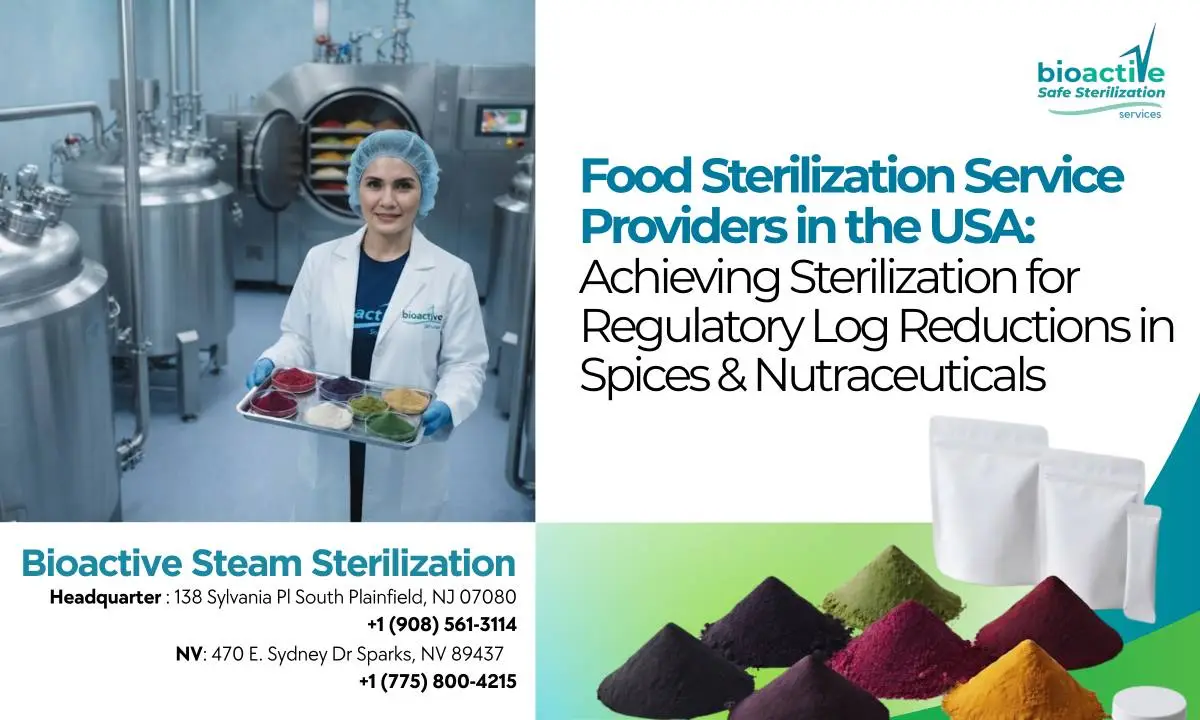
Food Sterilization Service Providers in the USA: Achieving Sterilization for Regulatory Log Reductions in Spices & Nutraceuticals
Introduction: Why Regulatory Log Reductions Matter for Spices and Nutraceuticals
Spices, herbs, botanicals, and nutraceutical powders are valuable ingredients, but they can also present important microbial-control challenges. Because many of these materials originate from agricultural environments, manufacturers must consider the possibility of microbial contamination before ingredients enter a finished food, supplement, or powdered formulation.
For manufacturers operating in the United States, selecting the right food sterilization service providers in the USA can therefore be an important part of an overall food-safety strategy.
At Bioactive Services, we understand that microbial reduction is not simply about applying heat to an ingredient. The objective is to develop and execute a commercially practical process that helps reduce microorganisms while protecting the characteristics that make the ingredient valuable.
For spices and nutraceuticals, this can include considerations such as flavor, aroma, color, potency, functionality, flowability, and formulation performance.
Our approach combines commercial steam sterilization with additional powder-processing capabilities, including toll blending, formulation, and packaging support.
What Is Sterilization for Regulatory Log Reductions?
Understanding Log Reduction in Food Safety
A log reduction describes the decrease in the number of viable microorganisms resulting from a treatment process.
For example:
Log Reduction | Approximate Reduction |
1-log | 90% |
2-log | 99% |
3-log | 99.9% |
4-log | 99.99% |
5-log | 99.999% |
A 5-log reduction represents a 99.999% reduction in the targeted microbial population under the defined processing conditions.
This is an important distinction: a 5-log reduction does not mean that a product is guaranteed to be completely sterile. Rather, it represents a defined level of microbial reduction against a target organism or population.
Why Regulatory Log Reduction Is Product-Specific
There is no single sterilization treatment that works identically for every food ingredient.
Spices, herbs, botanical materials, protein powders, functional ingredients, and nutraceutical blends can respond differently to heat and moisture.
The appropriate microbial-reduction strategy may depend on:
- Initial microbial load
- Target microorganisms
- Ingredient composition
- Particle size
- Moisture content
- Bulk density
- Packaging configuration
- Processing conditions
- Desired log reduction
- Product quality requirements
- Intended use of the ingredient
This is why manufacturers should evaluate food sterilization service providers in the USA based on their ability to work with the specific ingredient and processing objective.
Why Spices and Herbs Require Microbial Reduction
Agricultural Ingredients Can Carry Microorganisms
Spices and herbs frequently originate from agricultural supply chains. Harvesting, drying, handling, transportation, and storage can introduce opportunities for microbial contamination.
Even when an ingredient appears clean and dry, its microbial condition cannot necessarily be determined by appearance alone.
For manufacturers using spices and herbs in ready-to-use formulations, controlling microbial hazards earlier in the supply chain can provide an important processing advantage.
Steam Sterilization for Spices
Commercial steam treatment can be used as a microbial-reduction approach for selected spice ingredients.
The goal is to expose the product to controlled processing conditions capable of reducing targeted microorganisms while minimizing undesirable changes to the ingredient.
This balance is particularly important for spices because excessive processing can affect:
- Aroma
- Volatile compounds
- Color
- Flavor
- Texture
- Functional properties
A qualified processing partner should therefore evaluate microbial reduction together with product quality.
Steam Sterilization for Herbs and Botanicals
Herbs and botanicals can present similar challenges.
Their natural compounds and volatile components may be sensitive to processing conditions. Consequently, manufacturers often need a process designed around the characteristics of the individual material.
At Bioactive Services, we approach microbial reduction as a product-processing challenge rather than a one-size-fits-all treatment.
Steam Sterilization for Nutraceutical Powders
Why Nutraceutical Ingredients Need Microbial Control
Nutraceutical products frequently contain concentrated powders, botanical extracts, proteins, fibers, vitamins, minerals, or other functional ingredients.
The microbial quality of individual ingredients can influence the quality and safety of the finished formulation.
For this reason, manufacturers may seek steam sterilization service providers in the United States capable of processing nutraceutical ingredients and supporting broader powder-processing requirements.
Protecting Ingredient Quality During Processing
Microbial reduction must be balanced against the need to maintain product characteristics.
Depending on the ingredient, manufacturers may need to consider:
- Heat sensitivity
- Moisture sensitivity
- Active compounds
- Solubility
- Color
- Flavor
- Aroma
- Nutritional characteristics
- Powder flow
- Finished formulation performance
The best processing approach is therefore one that addresses the microbial objective without unnecessarily compromising the ingredient.
How Commercial Steam Sterilization Supports Microbial Reduction
Controlled Heat and Moisture
Commercial steam sterilization uses controlled heat and moisture to reduce microorganisms.
Unlike simply exposing a product to an uncontrolled heat source, commercial processing requires attention to the relationship between treatment conditions and the physical properties of the product.
For powdered ingredients, uniform exposure can be particularly important.
Process Conditions Must Be Evaluated
Successful microbial reduction depends on more than temperature alone.
Processing development may need to consider:
- Time
- Temperature
- Moisture
- Product characteristics
- Equipment configuration
- Loading conditions
- Target microorganisms
- Initial microbial population
- Desired reduction
These variables should be evaluated as part of a product-specific processing strategy.
Validation Is Critical
Manufacturers should distinguish between routine microbial testing and process validation.
Testing can provide information about a sample at a particular point in time. Validation, however, is concerned with demonstrating that a defined process can consistently achieve its intended microbial-reduction objective under specified conditions.
That distinction matters when selecting a commercial sterilization partner.
What to Look for in Food Sterilization Service Providers in the USA
Product-Specific Processing Expertise
A strong contract processing partner should understand that different ingredients behave differently during steam and heat treatment.
Ask whether the provider has experience with:
- Spices
- Herbs
- Botanicals
- Nutraceutical powders
- Food powders
- Functional ingredients
- Powder blends
The more closely the provider’s experience matches your product, the easier it may be to develop an appropriate processing strategy.
Microbial Reduction and Documentation
Manufacturers should also consider how a processor approaches:
- Target organisms
- Microbial testing
- Process documentation
- Batch traceability
- Quality controls
- Process consistency
- Customer specifications
Documentation becomes especially important when microbial reduction is part of a broader food-safety or quality program.
Commercial Scalability
A process that works at a small scale may require additional evaluation before commercial production.
When comparing companies offering commercial food sterilization in the United States, manufacturers should ask about the provider’s ability to support the project from development through production.
Important considerations include:
- Trial processing
- Production-scale processing
- Batch consistency
- Scheduling
- Material handling
- Packaging requirements
- Scaling requirements
Regulatory Log Reductions and the 5-Log Objective
What Does a 5-Log Reduction Mean?
A 5-log reduction corresponds to a 99.999% reduction in a targeted microbial population.
For example, if a hypothetical population began at 1,000,000 organisms and a process achieved a 5-log reduction, the theoretical surviving population would be approximately 10 organisms.
This illustrates the magnitude of the reduction, but actual process performance depends on the organism, product, process conditions, and validation parameters.
Is a 5-Log Reduction Required for Every Food Product?
No single 5-log requirement applies universally to every food or nutraceutical ingredient.
The appropriate microbial-control objective depends on the product, hazard analysis, intended use, customer requirements, applicable regulations, and validated processing strategy.
Therefore, manufacturers should avoid assuming that “5-log” automatically means regulatory compliance for every application.
Instead, the process should be evaluated against the specific microbial hazard and intended use.
Why Validation Matters More Than a Marketing Number
A processor advertising “5-log reduction” is not enough by itself.
Manufacturers should ask:
- What organism is being targeted?
- What product was processed?
- Under what conditions?
- How was the reduction demonstrated?
- Was the process validated for the actual product?
- What documentation is provided?
- Can the process be reproduced commercially?
These questions help manufacturers distinguish between a meaningful microbial-reduction program and a generic processing claim.
Beyond Sterilization: Toll Blending, Formulation, and Packaging
One Processing Partner Can Simplify Production
Microbial reduction is often only one step in a larger manufacturing process.
A manufacturer may need to:
Source ingredients → Reduce microbial load → Blend ingredients → Formulate product → Package finished material
Working with multiple vendors can create additional transportation, scheduling, documentation, and quality-control requirements.
An integrated processing partner can help streamline this workflow.
Toll Blending Services in the USA
Toll blending allows manufacturers to outsource the blending of ingredients according to defined specifications.
For powdered foods, spices, nutraceuticals, and functional formulations, toll blending may be integrated with microbial-reduction services when the product and process requirements allow.
Custom Formulation Support
Some projects require more than basic blending.
Custom formulation support may be appropriate when manufacturers need assistance with:
- Ingredient ratios
- Powder compatibility
- Product specifications
- Functional blends
- Nutraceutical formulations
- Food ingredient systems
Packaging Support
Packaging can also be part of the overall production workflow.
A processing partner capable of supporting sterilization, blending, formulation, and packaging can provide manufacturers with a more streamlined route from raw ingredient to finished product.
How to Choose the Right U.S. Food Sterilization Partner
1. Define Your Microbial Objective
Before contacting processors, identify the microbial-reduction objective as clearly as possible.
Consider:
- Target microorganisms
- Desired reduction
- Starting microbial levels
- Product specifications
- Intended application
- Regulatory or customer requirements
2. Ask About Product-Specific Validation
Do not rely only on a general statement that a processor can achieve a certain log reduction.
Ask how the process is evaluated for your specific ingredient.
3. Evaluate Quality and Traceability
A commercial processor should be able to explain how materials are identified, processed, documented, and tracked through production.
4. Consider the Entire Manufacturing Workflow
If you need blending, formulation, or packaging after microbial reduction, evaluate whether the processor can support those requirements as well.
5. Look for a Long-Term Processing Partner
The ideal relationship should support more than one production run.
As your product volume, formulation, or packaging requirements change, your processing partner should be able to adapt where appropriate.
Why We Provide Integrated Food Processing at Bioactive Services
At Bioactive Services, we believe manufacturers should have access to more than a single processing step.
Our focus is helping customers address the practical requirements associated with powdered ingredients, blends, food products, and nutraceutical applications.
Commercial Steam Sterilization
We provide commercial steam-based microbial-reduction processing designed around the requirements of the product and the customer’s processing objectives.
Microbial Reduction for Spices, Herbs, and Nutraceuticals
We support manufacturers seeking microbial-reduction solutions for ingredient categories where microbial control is an important consideration.
Toll Blending and Formulation
When sterilization is only one part of the manufacturing workflow, our broader processing capabilities can help connect microbial reduction with toll blending and formulation.
Packaging and Production Support
For projects requiring additional downstream processing, integrating packaging and other production requirements can help reduce the complexity of managing multiple processing partners.
Frequently Asked Questions
What is a 5-log microbial reduction?
A 5-log microbial reduction represents a 99.999% reduction in a targeted microbial population under defined processing conditions. It does not mean that the product is absolutely sterile.
Is 5-log reduction required for all spices and nutraceuticals?
No. Microbial-reduction objectives depend on the product, hazards, intended use, applicable requirements, customer specifications, and validated process.
Why are spices treated with steam sterilization?
Spices can acquire microorganisms through agricultural harvesting, drying, handling, and storage. Commercial steam treatment can be used to reduce targeted microorganisms while maintaining the ingredient’s desired characteristics.
Can herbs and botanicals undergo steam sterilization?
Selected herbs and botanicals can be processed using steam-based microbial-reduction approaches. The appropriate conditions depend on the specific material and its heat- and moisture-sensitive characteristics.
Is steam sterilization suitable for nutraceutical powders?
Steam-based processing may be suitable for selected nutraceutical powders, but each product should be evaluated individually because heat and moisture can affect different ingredients differently.
How do manufacturers verify microbial reduction?
Verification can involve microbiological testing, process monitoring, validation studies, and documentation appropriate to the product and processing objective.
What should I ask a food sterilization service provider?
Ask about product-specific processing experience, microbial targets, validation, testing, documentation, traceability, production capacity, and additional services such as toll blending and packaging.
Does Bioactive Services provide more than sterilization?
Yes. In addition to commercial steam sterilization and microbial-reduction processing, Bioactive Services supports powder-processing requirements including toll blending, formulation, and packaging.
Conclusion: Choosing the Right Food Sterilization Service Provider in the USA
For manufacturers of spices, herbs, botanicals, and nutraceutical powders, microbial reduction should be approached as part of a complete processing strategy.
The right food sterilization service providers in the USA should understand the relationship between microbial reduction, product quality, validation, documentation, scalability, and downstream manufacturing.
A 5-log reduction can be an important microbial-control objective, but it should always be evaluated in the context of the specific product, target organism, processing conditions, and applicable requirements.
At Bioactive Services, we take an integrated approach. Our commercial steam sterilization and microbial-reduction capabilities can be combined with toll blending, formulation, and packaging support to help manufacturers simplify their powder-processing workflows.
If you are looking for a U.S. processing partner for microbial reduction, steam sterilization, powdered ingredients, nutraceuticals, spices, herbs, or blended formulations, we invite you to explore how Bioactive Services can support your project from ingredient processing through finished-product production.