
-
admin
- March 23, 2026
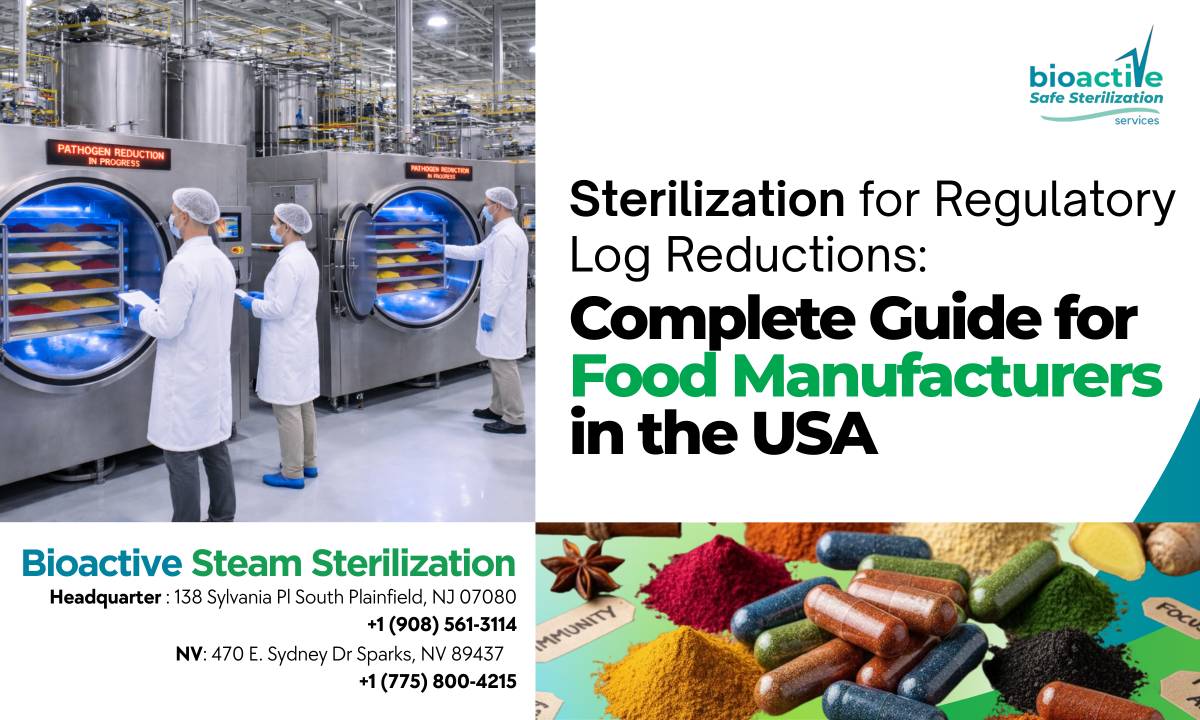
Sterilization for Regulatory Log Reductions: Complete Guide for Food Manufacturers in the USA
Food safety is one of the most important responsibilities in the modern food manufacturing industry. Ingredients used in food and nutraceutical products must meet strict microbial safety standards to protect consumers and comply with regulatory requirements.
One of the most important safety benchmarks is sterilization for regulatory log reductions, which ensures that harmful microorganisms are reduced to safe levels before ingredients enter the production process.
At Bioactive Services, we work closely with food manufacturers to provide steam sterilization, microbial reduction, and toll blending services that help companies achieve regulatory compliance and maintain the highest standards of food safety.
This guide explains how regulatory log reductions work, why they are required, and how sterilization solutions support food manufacturers across the United States.
What Are Regulatory Log Reductions in Food Safety?
Regulatory log reductions refer to the reduction of microorganisms in food ingredients through validated processing methods.
The term log reduction is used to describe how many microorganisms are eliminated during a sterilization process.
Understanding Log Reduction in Microbial Control
Log reduction is measured on a logarithmic scale.
Examples include:
- 1-log reduction = 90% reduction in microbes
- 2-log reduction = 99% reduction
- 3-log reduction = 99.9% reduction
- 4-log reduction = 99.99% reduction
- 5-log reduction = 99.999% reduction
For food safety applications, 5-log pathogen reduction is often considered the industry standard for eliminating harmful bacteria.
Why the FDA Requires Log Reduction Standards
The U.S. Food and Drug Administration (FDA) and the Food Safety Modernization Act (FSMA) require food manufacturers to implement preventive controls that reduce contamination risks.
These regulations are designed to ensure that ingredients used in food production are safe for consumption.
Sterilization processes validated for log reduction provide manufacturers with documented proof that their ingredients meet safety requirements.
The Importance of 5-Log Pathogen Reduction
A 5-log pathogen reduction reduces microbial contamination by a factor of 100,000.
For example:
100,000 bacteria → reduced to 1
Achieving this level of microbial control significantly reduces the risk of contamination and foodborne illness.
For many powdered ingredients such as spices, herbs, and nutraceutical blends, sterilization processes must demonstrate this level of reduction.
Why Sterilization Is Critical for Achieving Regulatory Compliance
Sterilization technologies play an essential role in achieving regulatory log reduction requirements.
Without proper microbial reduction processes, food manufacturers risk product recalls, regulatory violations, and potential harm to consumers.
Microbial Risks in Food Ingredients
Many food ingredients originate from agricultural environments where microorganisms naturally occur.
Common pathogens found in raw ingredients include:
- Salmonella
- E. coli
- Bacillus species
- Listeria
- Yeasts and molds
Powdered ingredients are particularly vulnerable because they are often dried and processed in conditions that allow microbes to survive.
FSMA and Preventive Control Requirements
The Food Safety Modernization Act (FSMA) shifted the focus of food safety from reaction to prevention.
Manufacturers must now implement preventive controls that minimize contamination risks.
Validated sterilization processes that achieve regulatory log reductions are a key component of these preventive control strategies.
Avoiding Food Safety Recalls and Contamination
Food recalls can have devastating financial and reputational consequences.
Sterilization services help manufacturers avoid these risks by ensuring that ingredients meet microbial safety standards before they are incorporated into finished products.
Sterilization Technologies Used to Achieve Regulatory Log Reductions
Several sterilization technologies are used in the food industry to achieve regulatory log reductions.
Among these, steam sterilization remains one of the most effective methods for powdered ingredients.
Steam Sterilization for Powdered Ingredients
Steam sterilization uses high-temperature steam and controlled moisture to eliminate microorganisms.
The process typically includes:
- Loading ingredients into sterilization chambers
- Controlled steam exposure
- Temperature and humidity monitoring
- Rapid cooling and drying
This method effectively destroys harmful microbes while preserving the natural characteristics of food ingredients.
Thermal Microbial Reduction Systems
Thermal sterilization systems use controlled heat to reduce microbial populations.
These systems are designed to achieve consistent log reductions while maintaining product quality.
Controlled Moisture Sterilization for Sensitive Ingredients
Sensitive ingredients such as herbs and nutraceutical powders require carefully controlled sterilization environments.
Advanced sterilization systems regulate moisture and temperature to protect active compounds and flavors.
Bioactive Services: Supporting Regulatory Log Reduction Compliance
At Bioactive Services, we provide specialized solutions designed to help manufacturers meet regulatory microbial reduction standards.
Our goal is to deliver safe, compliant, and high-quality ingredients through advanced sterilization technologies.
Validated 5-Log Pathogen Reduction Processes
Our sterilization systems are validated to achieve 5-log pathogen reduction, helping food manufacturers comply with U.S. food safety regulations.
Each batch undergoes strict monitoring and microbial verification to ensure consistent results.
Steam Sterilization for Spices, Herbs, and Nutraceuticals
We specialize in steam sterilization for powdered ingredients, including:
- spices and seasonings
- botanical ingredients
- herbal powders
- nutraceutical formulations
Our process preserves flavor, color, and active compounds while eliminating harmful microorganisms.
Integrated Toll Blending and Powder Processing
In addition to sterilization, Bioactive Services offers toll blending services in the USA.
Our capabilities include:
- custom ingredient blending
- formulation development
- batch scaling
- packaging support
This integrated processing approach simplifies production and ensures consistent quality.
Industries That Require Sterilization for Regulatory Log Reductions
Many industries rely on sterilization services to ensure product safety and regulatory compliance.
Spice and Seasoning Manufacturers
Spices are often exposed to environmental contaminants during harvesting and drying.
Steam sterilization ensures these ingredients meet food safety standards before they are used in food production.
Nutraceutical and Dietary Supplement Producers
Dietary supplements must meet strict microbial limits to ensure consumer safety.
Sterilization processes help manufacturers maintain compliance and product integrity.
Botanical and Herbal Ingredient Suppliers
Botanical ingredients used in teas, extracts, and herbal supplements must be free from harmful microbes.
Sterilization helps ensure safety while preserving natural properties.
How Food Manufacturers Choose Sterilization Partners
Selecting the right sterilization partner is essential for maintaining product safety and regulatory compliance.
Compliance Documentation and Validation
A reliable sterilization partner should provide:
- validated microbial reduction processes
- regulatory documentation
- microbial testing results
- traceability systems
Technology and Processing Capabilities
Advanced sterilization equipment ensures consistent microbial reduction across large production volumes.
Experience with Powdered Ingredients
Processing powdered ingredients requires specialized expertise.
Experienced sterilization providers can ensure effective microbial reduction while protecting product quality.
Conclusion: Achieving Regulatory Log Reductions with Bioactive Services
Sterilization for regulatory log reductions is a critical component of food safety in the United States.
Manufacturers must ensure that ingredients meet strict microbial reduction standards to comply with FDA regulations and protect consumers.
At Bioactive Services, we help food manufacturers achieve these goals through validated steam sterilization, 5-log pathogen reduction, and toll blending services for powdered ingredients and formulations.
By partnering with experienced sterilization experts, companies can streamline production, maintain regulatory compliance, and deliver safe products to the market.
Learn more about our services at:
https://bioactive-safesterile.com/